By happenstance this month I watched a Flemish TV series about a family in World War I and read a book by a Flemish author who discovered his house was occupied by an SS officer in World War II. Both were set in Ghent, my mother’s home town, where I spent many happy childhood times and have visited often throughout my life. Both offered a fuller context to the stories passed down to me about my own family’s experiences in the World Wars.
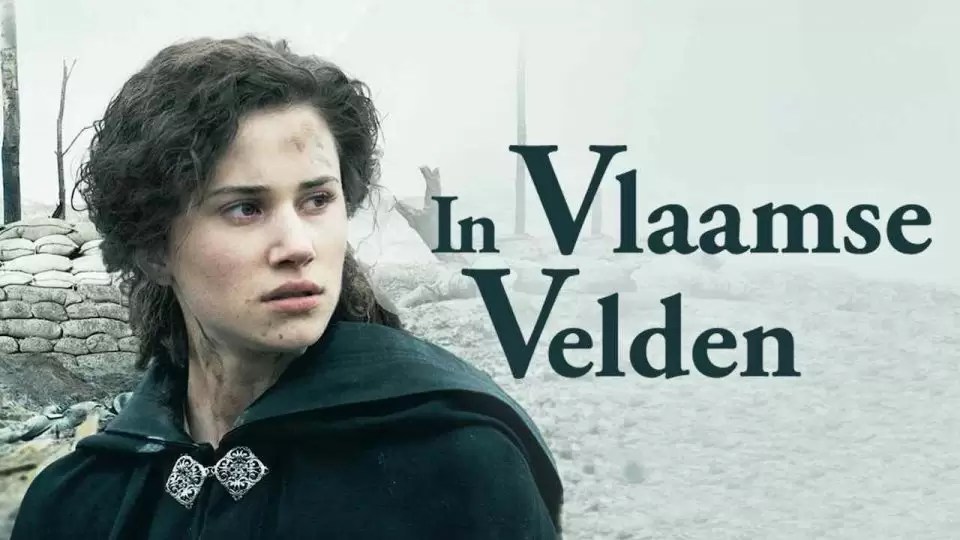
I watched the ten episodes of In Vlaamse Velden on PBS Passport, in Flemish with English subtitles. It was lovely to hear Flemish, a language that surrounded me in my childhood. I felt good when I was able to pick up familiar words and expressions, even some entire sentences, but I did need the subtitles. The series tells the story of Dr. Boesman, a gynecologist, his wife Virginie, sons Vincent and Guillaume, and daughter Marie. Each experiences the war in a different way, illustrating the complex and divided loyalties of the Flemish people during German occupation.

Dr. Boesman believes the Germans will win and that he may at last gain a professorship at the University of Ghent, till now denied to Flemish speakers. The class divide between Flemish and French speaking Belgians is exploited by the Germans who claim a cultural kinship with the Flemish Independence movement. The language divide also compromises the effectiveness of the Belgian Army. The officer class are French-speaking while most of the enlisted men are Flemish and cannot understand their orders. Vincent Boesman plays a crucial role in his unit, translating for the officers and winning promotion. A scene where Vincent’s unit travels towards the front on bicycles underscores the inadequacy of the Belgian forces. Meanwhile free-spirited younger brother Guillaume deserts the army, but is captured by the French and pressed into service. His war experiences will profoundly change him.
When the Germans capture Ghent a commander and his aide take over the Boesman home for their headquarters. From now on, he says, the dining room is Germany and the kitchen Belgium. Virginie Boesman resists the authority of the Germans in quiet but steely ways. She joins a church group of upper class women in setting up a soup kitchen for the poor who are suffering severe food shortages. I imagined my own working class family in the soup lines. My great-grandfather Emiel was a hoefsmid, a blacksmith, who moved from the countryside to Ghent in the late nineteenth century to work for the city’s horse-drawn tram service. My grandfather Gentil was fourteen when the Germans invaded and began rounding up young men. My mother told the story of how he tried to escape by running along the rooftops. But he was captured and sent to Germany to work in a factory labor camp, an experience he never forgot or forgave.

Daughter Marie Boesman’s story is the heart of In Vlaamse Velden. She dreams of becoming a doctor like her father, an ambition considered impossible at the time. Once Ghent is occupied by the Germans she daringly works for the Resistance, carrying messages back and forth on her bicycle. She and the young German officer living in her house are attracted to one another and when Marie falls under suspicion he helps her escape. She reaches England and trains as a nurse, returning to Flanders to care for the wounded on the battlefield.
The series captures the Flemish people’s experience of war in all its complexity. We meet the brave and the cowards, the collaborators and the resistance, the good and the bad among the Germans and the Belgians. Those who bet on a German victory face the consequences. At war’s end Dr. Boesman is spat upon by his neighbors, his house disfigured by graffiti, and his medical practice devoid of patients. His dream of a professorship is dust.

Many of the same themes of collaboration and resistance were repeated in World War II, as illustrated by Stefan Hertmans’ history of a house in Paterschol, the old medieval heart of Ghent. When he was a young man in the late 1970’s Hertmans came upon an old abandoned house, moldy with damp from the nearby River Leie. It was for sale at a price he could afford. He cleared out all the rubbish inside, things that had no meaning at the time, renovated in stages, and lived there for twenty years. Two weeks after he sold it he came upon a book by Adriaan Verhulst, a history professor who had been his teacher. Zoon van den “foute” Vlaming, (Son of a “bad” Fleming) was a confessional memoir about growing up in a house in Ghent, the son of an SS Officer. The book revealed that it was the very same house Hertmans had just sold. Verhulst had died, so could no longer answer all the lingering questions he had evaded in his memoir. So Hertmans spent the next several years in an obsessive search for the truth about the family who had lived in his house during the war.
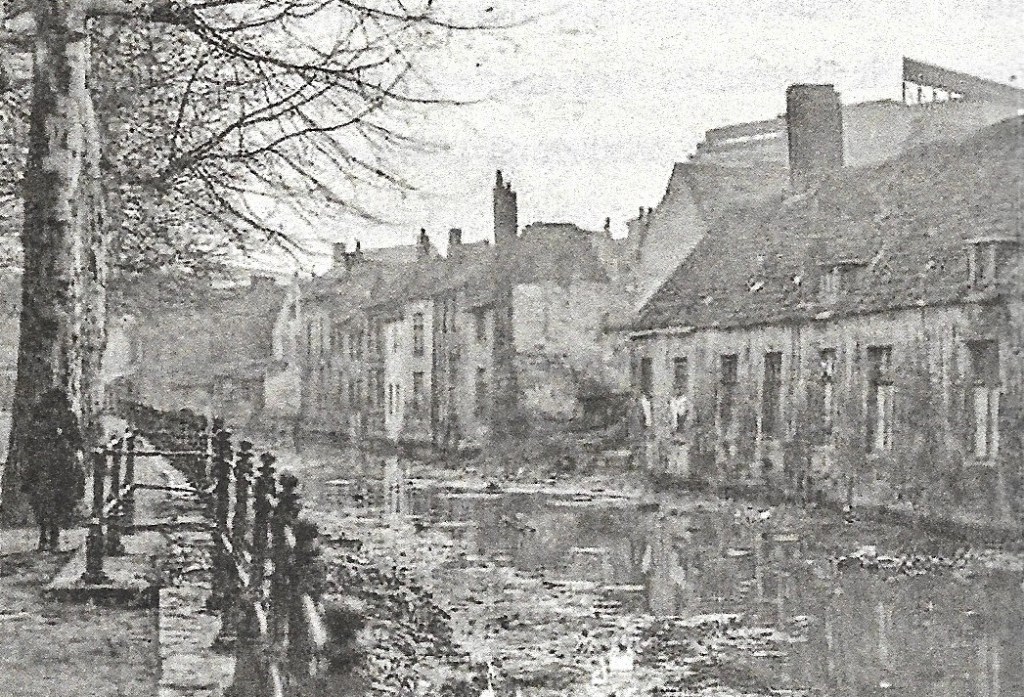
Hertmans structures the book after his first tour of the house with the estate agent, starting in the flooded basement and ascending the staircase through the levels of the tall narrow house to the attic. Ironically, from here there is a clear view of another attic that was the secret headquarters of the Resistance during the war. As Hertmans explores the ruined house he reveals the shocking and tragic history of a family.

When I first heard about this book I assumed the SS officer who had lived in the house was German, like the German who took over Dr. Boesman’s house in the TV series. But no, this SS officer was Flemish. Willem Verhulst was a dedicated member of the Flemish Nationalist Party. His first wife was Jewish. After she died of cancer he married a Dutch farmer’s daughter, Harmina, known as Mienje. She was five years older than him and her father bitterly opposed the match, describing his future son-in-law as a “Belgian ding-a-ling.” The couple moved to Ghent for Willem’s salesman job, bought the house in Paterschol, and had three children.
When the Germans occupied Belgium in 1940 they exploited the Flemish Nationalist movement as they had in the first war. Willem, whose devotion to the movement bordered on the fanatical, was among many who chose collaboration with Germany as a means to Flemish independence. But few went as far as Willem. He volunteered to work for the SS. Soon he had his own uniform and held regular meetings with German SS officers in the front room of his house. He displayed a bust of Hitler on the mantel. Mienje was so horrified that she called the room the “death room” and kept the door locked in the day so her children wouldn’t see inside. The Verhulst children grew up in an atmosphere of secrets and toxic arguments between their parents, fearful of what lay behind the locked door and why their father spent so many evenings there with visitors. Mienje was consumed with anger and shame, and betrayal as she realized her husband was carrying on an affair with a beautiful younger woman, another dedicated Flemish Nationalist collaborator.

Willem Verhulst was appointed head of the German propaganda radio station in Ghent. His other work was compiling lists of his fellow Ghent residents who were suspected of being in the Resistance, or were otherwise anti-German, or Jewish. Yes this man who had been passionately in love with his Jewish wife in his youth was now targeting Jews for deportation to the concentration camps. From his office in the SS building he could hear the screams of prisoners being tortured in the basement.
As the Allies neared Ghent in 1944 and German defeat seemed inevitable, Willem’s neighbors turned on him. No longer afraid of his power they spat on him in the street and threatened violence. As the Germans retreated from the city Willem fled after them.
As this dark history played out in the Paterschol my mother Lydia was a teenager, across town in the little house on Haardstedestraat I would come to know as a child. Widowed in the first year of the war, my grandmother Camilla had to place my mother’s two younger brothers in the city orphanage because she could not afford to feed them. My mother worked as a home help for a wealthy French-speaking family who gave her a glass of milk every day. She told many stories about her wartime experiences, including these: She and a friend would cycle out to countryside farms to buy food items like butter and eggs on the Black Market. Once they hid in a ditch from a German patrol, terrified their illegal purchases would be found. One day my grandmother was approached by a Resistance group who were spiriting Jews to safety. Would she take in a Jewish boy for one night? She agreed but the boy never showed up; one can only imagine his fate.

When the Allies liberated Ghent among them was a young British soldier, my father Frank. He met Lydia at a dance and they somehow managed to communicate despite my mother’s “leetle” English. I tell more of their story in The Message in the Laundry.
Willem Verhulst did not escape to Germany; he was captured and sent to a prison in Flanders. At his trial in 1946 the evidence included a document in which he argued for the “radical extermination of all centers of degeneracy and bastardisation in Flanders.” He was found guilty and given the death penalty, but it was later commuted to life imprisonment. For unknown reasons he was released in 1953. He never renounced his extreme Nazi ideology.


 Dispatches From the Former New World
More fascinating memories. Links uo with the book I have just translated from the French. ‘Beyond the Darkness’ is the horrendous memoir of an Armenian in the French Resistance. Captured by the Nazis he survived 3 death camps and a ‘death march’ to return to Paris and open a shoe shop. That was where I first met him. He was the father of a friend I taught English to in 1969! She translated her father’s memoir from the Armenian. Now I need to find a publisher – I am sure there is an American market for it, heavily annotated as it is to explain people, places and things for the uninitiated.
LikeLike
Thank you for your story connecting this film to your own personal life experience. I recently saw this film series also and was again appalled by Nazi horrors and injustices. This was not my first exposure to this history; it resonates with me, although my ancestry is English and Welsh. For some reason, I am drawn to these World War books and films, and they leave me with sobering thoughts about our future. People never learn, do they?
LikeLike