
The first thing I want to say about this new addition to my bookshelf is that I absolutely adore the cover. I don’t believe in judging a book by its cover, but I do judge book covers. I follow the Best Book Covers of the Year lists and pass my own judgements on the latest design hits and misses. When will the cliche of the “young woman seen from behind” covers be over? The current fashion is for splashes of garish color and odd images designed to shock or defy explanation. In contrast this cover is an inspired fusion of subject and image. The perfect Delft blue color, of course, and the woman-shaped shard of Delftware have an instant visual appeal and tell the story of the book’s contents – the revelation that many of the famous Delft potteries of the 17th and 18th centuries were owned and managed by women.

Genevieve Wheeler Brown is a decorative art advisor who stumbled on this story by chance when she was asked to appraise a large collection of Delftware stored in the New York headquarters of a women’s art organization. When she stepped into the room, untouched for decades, she was amazed to find a superb collection of over seventy-five blue and white Delftware objects, an overwhelming display of beauty and craftsmanship in a myriad shapes and sizes. This treasure, she learned, had been acquired in the Gilded Age when a fashion for collecting Delftware had obsessed wealthy New York socialites. Brown soon became obsessed herself with researching the history of Delftware.
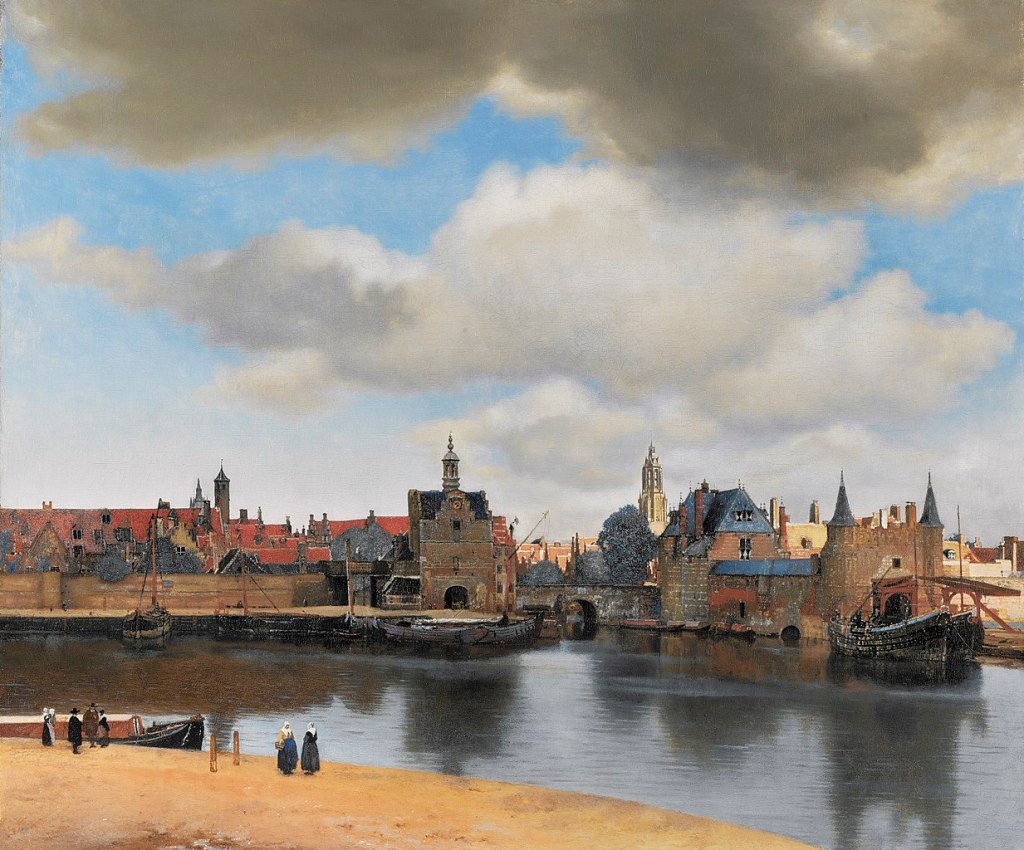
It all began with an act of piracy. In the South China Sea on February 25th 1603 the Witte Leeuw and the Alkmaar, ships of the new Dutch East India Company, spotted the Santa Catarina, a massive Portuguese galleon loaded down with goods from China.. The Dutch opened fire, aiming their cannons on the sails to immobilize the ship without destroying its cargo. After a day of fierce fighting they seized the Santa Catarina and hauled its cargo home to Amsterdam where they unloaded countless chests and crates with “a vast array of treasures.” There was silk, brocade, spun gold, spices, and sixty tons of blue and white porcelain, over 100,000 pieces. The collection was sold at a public auction in 1604, attracting buyers from all over Europe and inspiring an “unquenchable thirst” for Chinese porcelain. How could the potters of Delft compete? They were producing tin-glazed earthenware but could not match the pure white glassy sheen of Chinese porcelain. Chinese techniques were a closely guarded secret. Delft potters began to experiment and eventually hit upon a method of dipping the earthenware in a white coating before finishing with a lead glaze. By 1625 there were eight potteries producing Delft Porcelyne, as it was called. At first copying the Chinese blue painted patterns, Delft potters soon developed their own distinctive artistic style, immediately recognizable today.
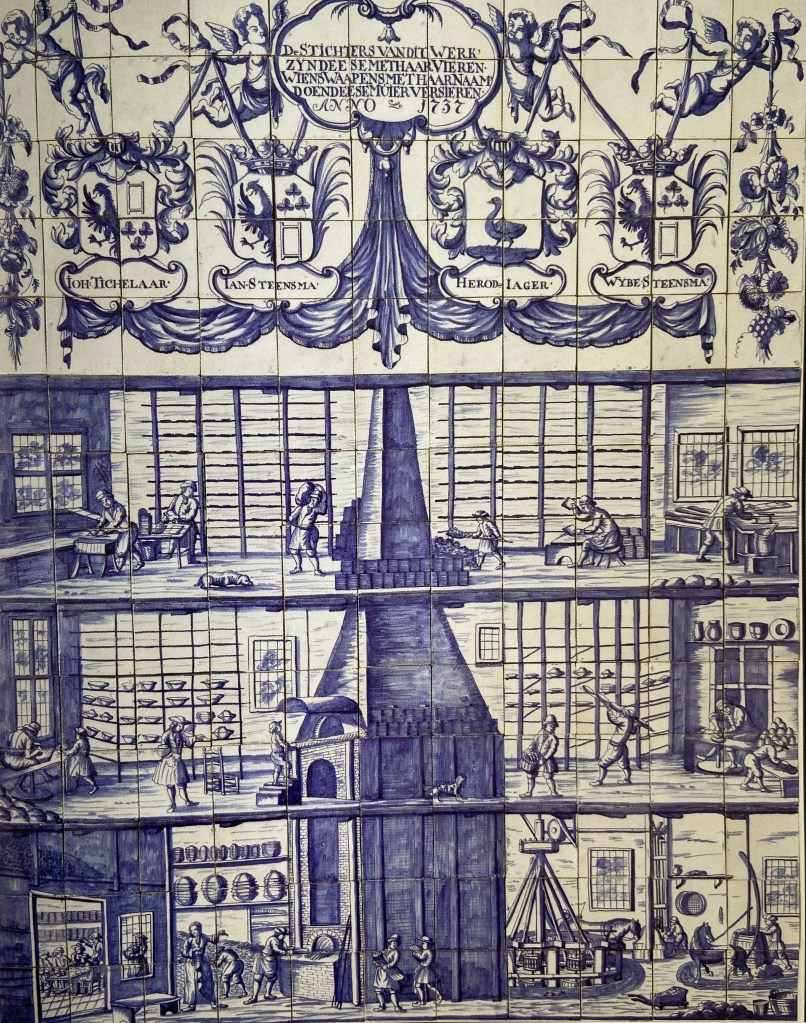
The potteries of Delft were regulated by the Guild of St. Luke. There were annual dues for membership and the plateelschilders, the potters and painters, had to pass a rigorous Master’s test. Each pottery was required to have one winkelhouder, an owner/manager who must also be a paid up member of the Guild and obey its laws. The Guild was governed by a board of six Hoofdmannen or headmen. A famous name comes up in the history of the Guild. The painter Vermeer served as a hoofdmannen for several terms during the 1660’s and 70’s. Among the voluminous lists of rules and regulations enforced by the Guild there was no regulation that prevented a woman becoming a winkelhouder. As Brown discovers, from the mid 17th to the mid 19th century a quarter of Delft pottery owners were women.
This came about because of the unique position of women in the Dutch Republic. Women were much freer here than in other European countries, free to move about unaccompanied, to engage in business, and even to inherit property equally with their brothers. Foreign visitors often expressed surprise at Dutch women’s behavior. Sir William Montague wrote in The Delights of Holland in 1696:
Tis very observable here, more Women are found in the Shops and Business in general than Men; they have the Conduct of the Purse and Commerce, and manage it rarely well, they are Careful and Diligent, capable of Affairs, having an Education suitable, and a Genius wholly adapted to it.
The Italian merchant Guicciardini was less complimentary, writing in 1567:
The women govern all, both within the doors and without, and make all bargains, which joined with the natural desire that Women have to bear rule, maketh them too too imperious and troublesome.
One of the most successful female winkelhouders whose story Brown uncovers was Barbara Cornelisdochter Rotteveel, who founded De Drie Klokken (The Three Bells) pottery. Born in Delft in 1627 she grew up in a townhouse on the canal in a prosperous family. One of her neighbors was a little boy named Johannes Vermeer. She lived through the cataclysmic event in 1654 known as the Thunderclap, when a huge store of gunpowder exploded destroying a large part of central Delft and killing hundreds. One of the victims was the young artist Carel Fabritius, painter of the famous Goldfinch. At this time Barbara was recently widowed with three young children and Delftware was booming. She purchased an abandoned brewery on the canal and her name was entered into the Master Book of the Guild of St. Luke by her former childhood neighbor Vermeer. Barbara oversaw the pottery for thirty-three years until the age of seventy-six. In 1706 she gave the ownership to her grandson Pieter Mesch who had passed the Guild’s Master Potter exam. At her death a year later a notary made a detailed inventory of the contents of her home and business. The surviving document records the fruits of her skill as a successful businesswoman. In addition to Delftware she owned a fine silverware collection, gold and diamond jewelry, Chinese porceleyne, furniture made of rare tropical woods, and many paintings by Dutch artists, including portraits of her children. The pottery she founded would thrive for another century.
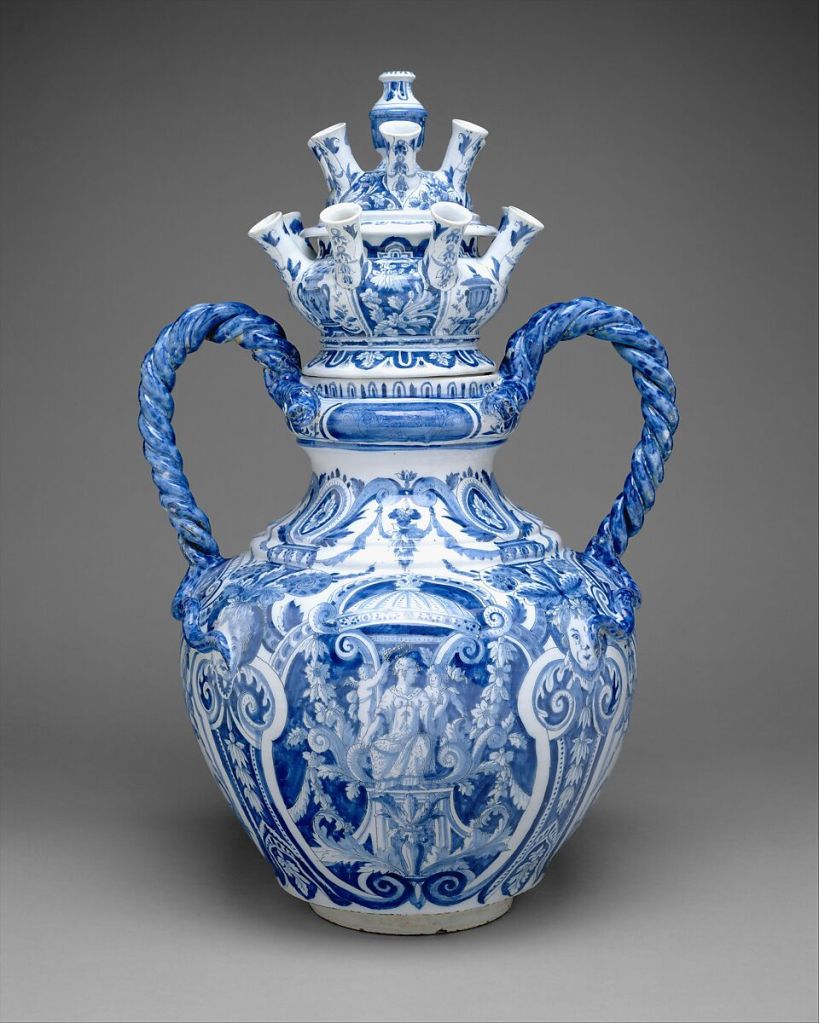
Barbara Rotteveel founded her own pottery, but it was more common for women to take over the family business when they were widowed. This was the case with Johanna van der Huel who became winkelhouder of De Grieksche A (The Greek A) pottery when her husband Pieter died in 1703 after five years of marriage. It was just two years after he had inherited the business from his father. De Grieksche A was one of the most prestigious potteries with wealthy clients including European royalty. Joanna was an innovator. Under her leadership the pottery began to produce Delftware in the Japanese Imari style, designs inspired by Asian fabrics called cashmere style, and most unusual of all, rare black Delftware. After twenty years Joanna sold the pottery to another woman, Cornelia van Willigen.
Women, and widows especially, were recognized as an important part of the Dutch economy. In 1668 Joseph Child wrote that the abundance of widows in business:
…doth encourage their Husbands to hold on in their Trades to their dying days, knowing the capacity of their Wives to get in their Estates, and carry on their Trades after their Deaths.
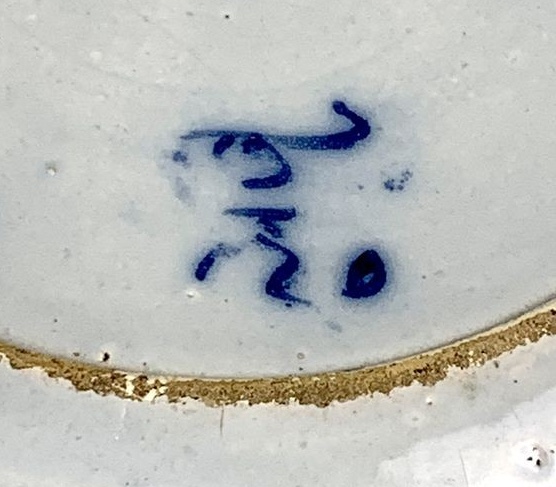
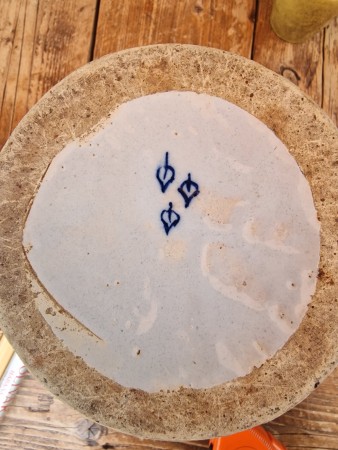
Exploring the archives Brown discovers many more women creating Delftware whose full stories may never be known. The woman-owned potteries included The Peacock, The Fortune, The Hart, The Young Moor’s Head, The Porcelain Bottle, The Porcelain Dish, The Metal Pot, and my favorite pottery name, De Porceleyne Claeuw (The Porcelain Claw), its mark shown on the left.
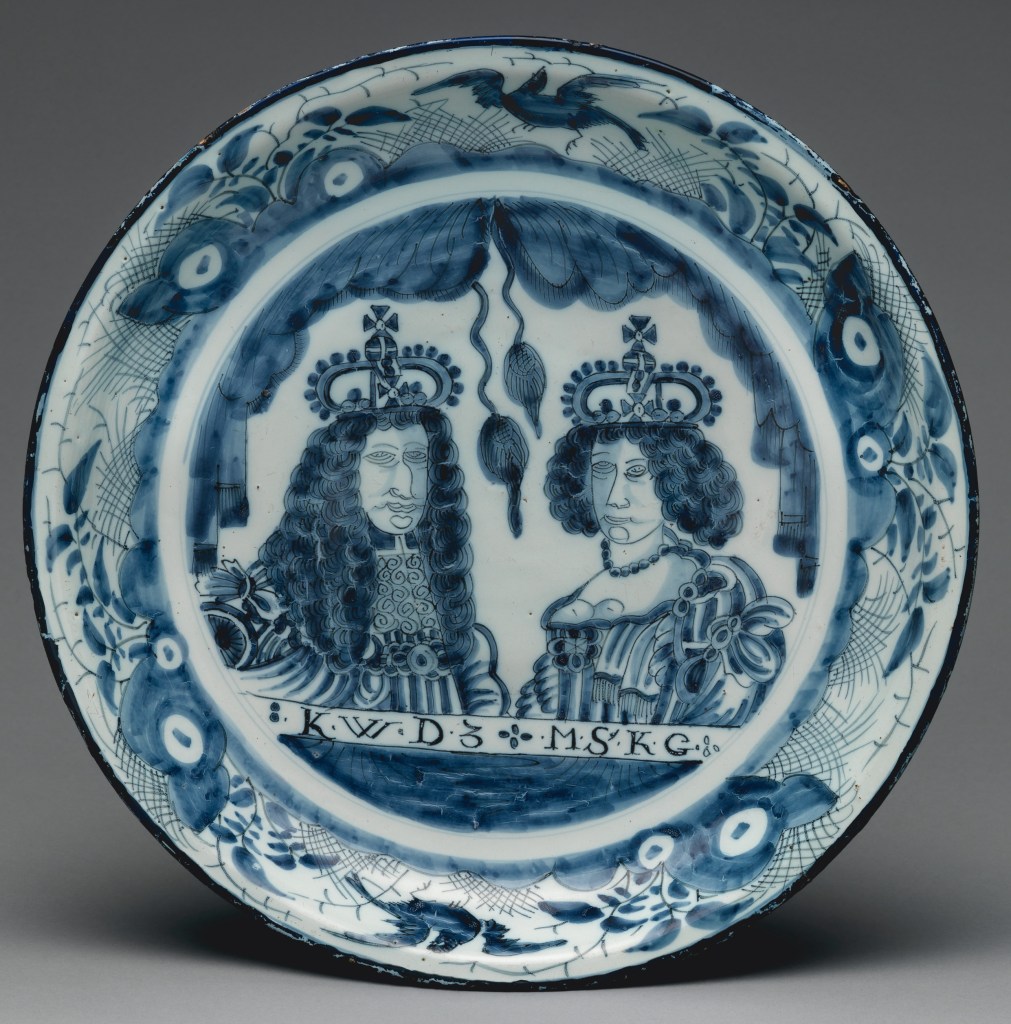
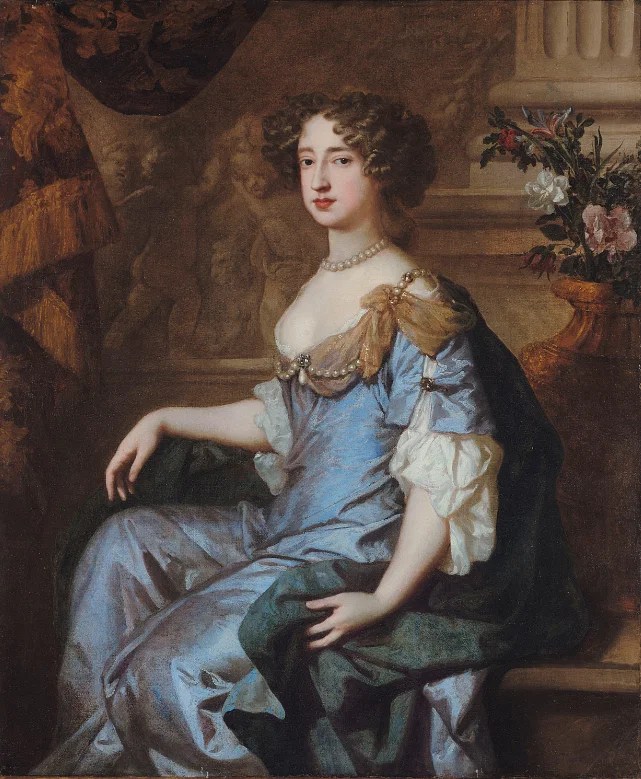
One of the most influential royal patrons of Delftware was Queen Mary II who ascended the English throne with her husband William of Orange in the Glorious Revolution of 1688. Mary grew up at the English court, daughter of the future King James II. At the age of fifteen her father informed her that she was to marry the Prince of Orange, a man twelve years older, “whereupon her highness wept all that afternoon and the following day.” Mary dreaded leaving England but once settled in the Dutch Republic she fell in love with her new home. She found the Dutch lifestyle a refreshing change from the stuffy formality of the English court. She loved the scenic countryside, the beautiful gardens , and most of all the gleaming blue and white Delftware. She became an avid collector, commissioning bespoke pieces, and eventually amassing one of the largest collections of Delftware ever assembled.
When Mary returned to England in triumph in 1688 to become co-ruler with William she brought her Delftware collection with her. After the coronation ceremony William and Mary gave their supporters gifts of Delftware vases decorated with their royal arms and ciphers. Soon Delftware was all the fashion in aristocratic England. Nobles began commissioning their own pieces from prestigious potteries like De Grieksche A, displaying them prominently in their country houses as a show of loyalty. But nothing could compare with the private Delftware display building Mary created for herself at Hampton Court.
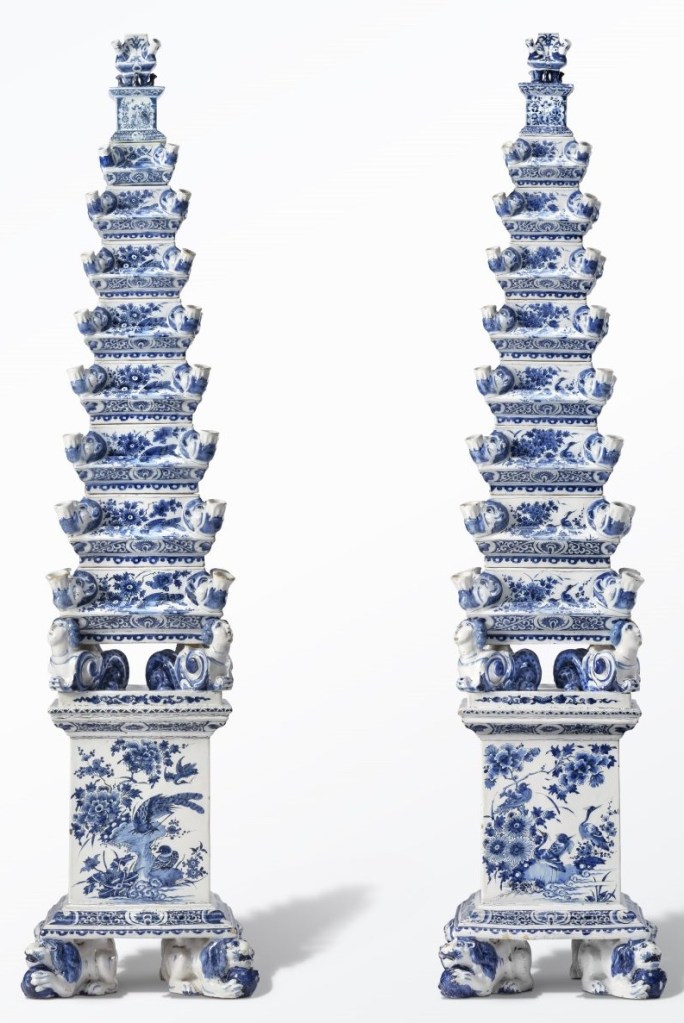
The monarchs began a major renovation of Hampton Court under the supervision of Christopher Wren. Mary envisaged it as a new Versailles. An old boathouse or “watergate” across the garden by the River Thames became her pet project. Calling it the Water Gallery, Mary transformed the humble building into an opulent retreat and jewel-like setting for her Delftware collection. The design included terraces, grand galleries, and intimate salons. On the lower level was a Queen’s Bath made to look like a grotto with faux rocks, and a pleasure Dairy with Dutch tiled walls and shelves of Delft milk pans. Here Mary could serve her guests fresh dairy products, in Delftware cups and bowls of course. (This was a century before Marie Antoinette became famous for playing milkmaid at her pretend farm in Versailles). Above the dairy was the magnificent main gallery filled with cornices, brackets, and mantels to display Delftware. Daniel Defoe described it as “a fine collection of Delft Ware, which indeed was very large and fine, the like whereof was not then to be seen in England.” He was awed by the crown jewels of the collection, the bloemenpiramides, pyramid flower vases, towering up to five feet tall. These vases were made in tiers with multiple spouts to hold cascading flower arrangements.
The Water Gallery did not last long. After Queen Mary died of smallpox in 1694 her Delftware collection was dismantled and dispersed, many pieces given as gifts in her memory. A few years later William ordered the Water Gallery demolished to extend his privy garden to the banks of the Thames. Her dream Gallery was gone, but Mary’s influence on English enthusiasm for Delftware lived on. In fact English potteries began making their own version, called English Delftware.
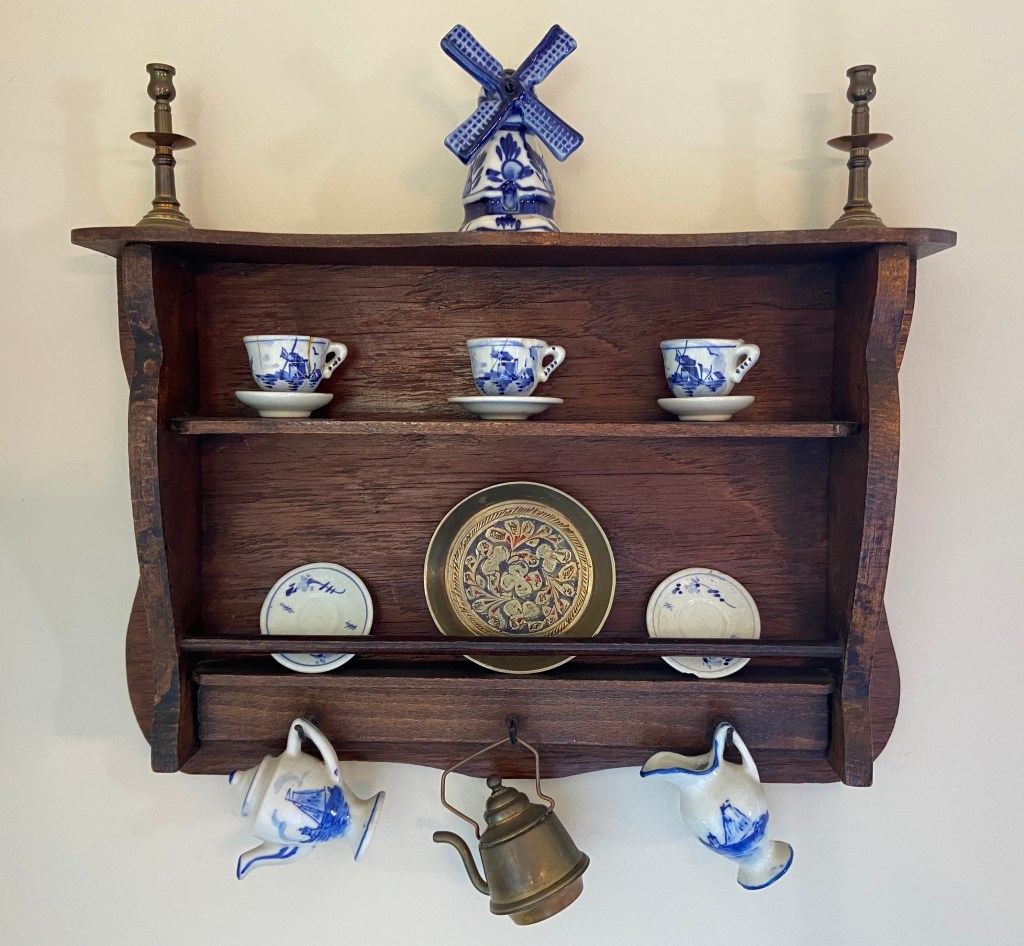
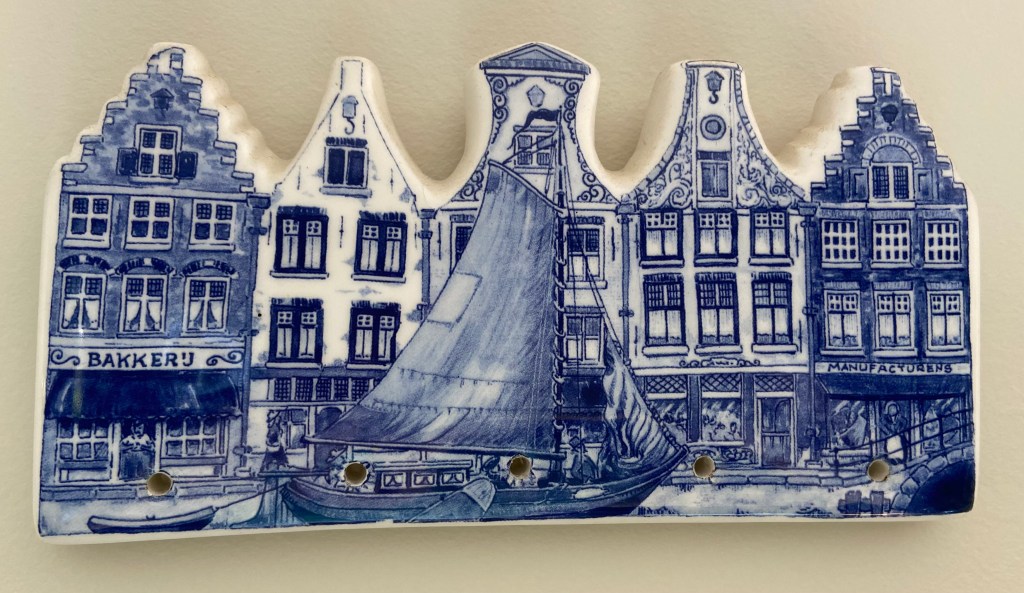
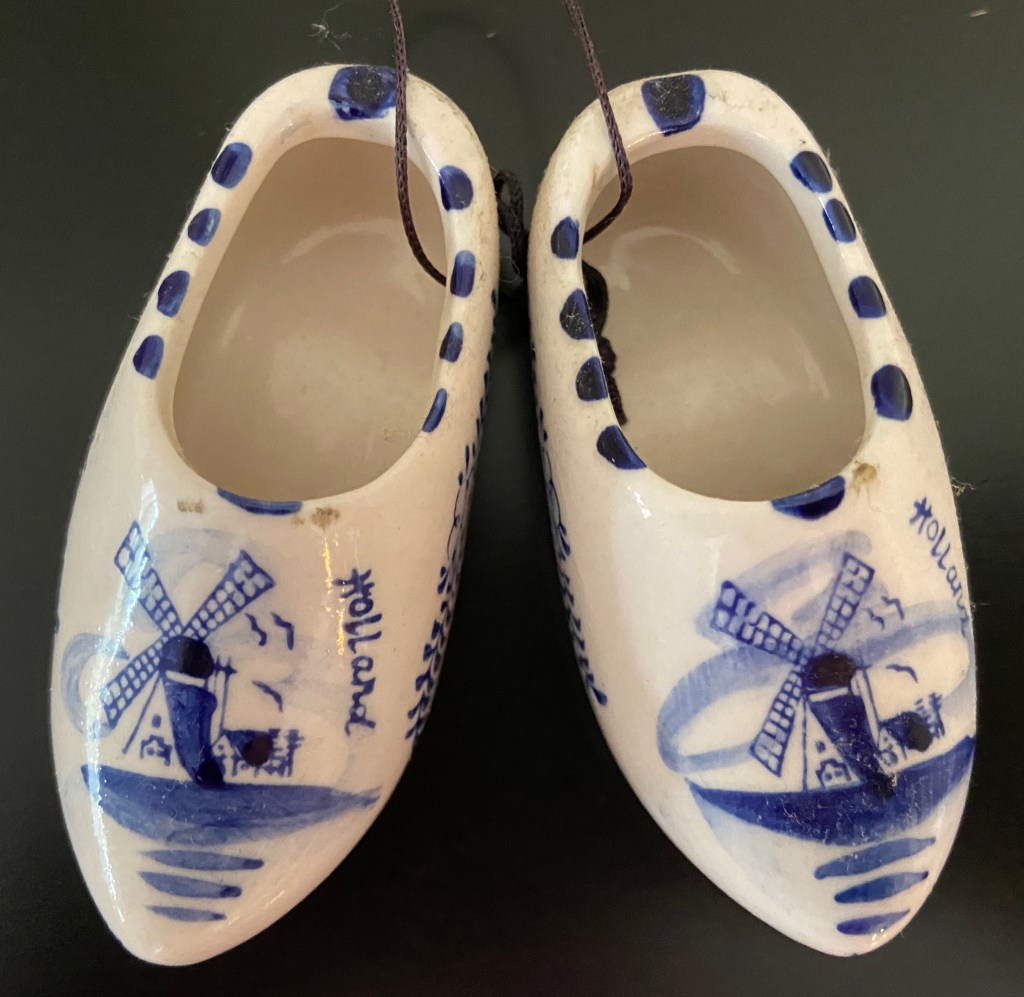
I have a particular interest in Delftware because I inherited the little cabinet above from my mother. It hung on our kitchen wall for as long as I remember. My mother was from Ghent in Flanders, the Dutch speaking region of Belgium which is culturally akin to Holland. She brought this with her when she moved to England after her wedding in 1947. The cups and saucers and plates are very old; I think they go back to my Flemish grandmother’s childhood. Two of the cups were shattered into many pieces at one point and repaired with glue that has turned yellow in the cracks. The brass pieces are also traditional in a Flemish kitchen. (Now I see the photo it looks as though they could use a polishing!) Over the years I’ve collected other small pieces of Delftware:
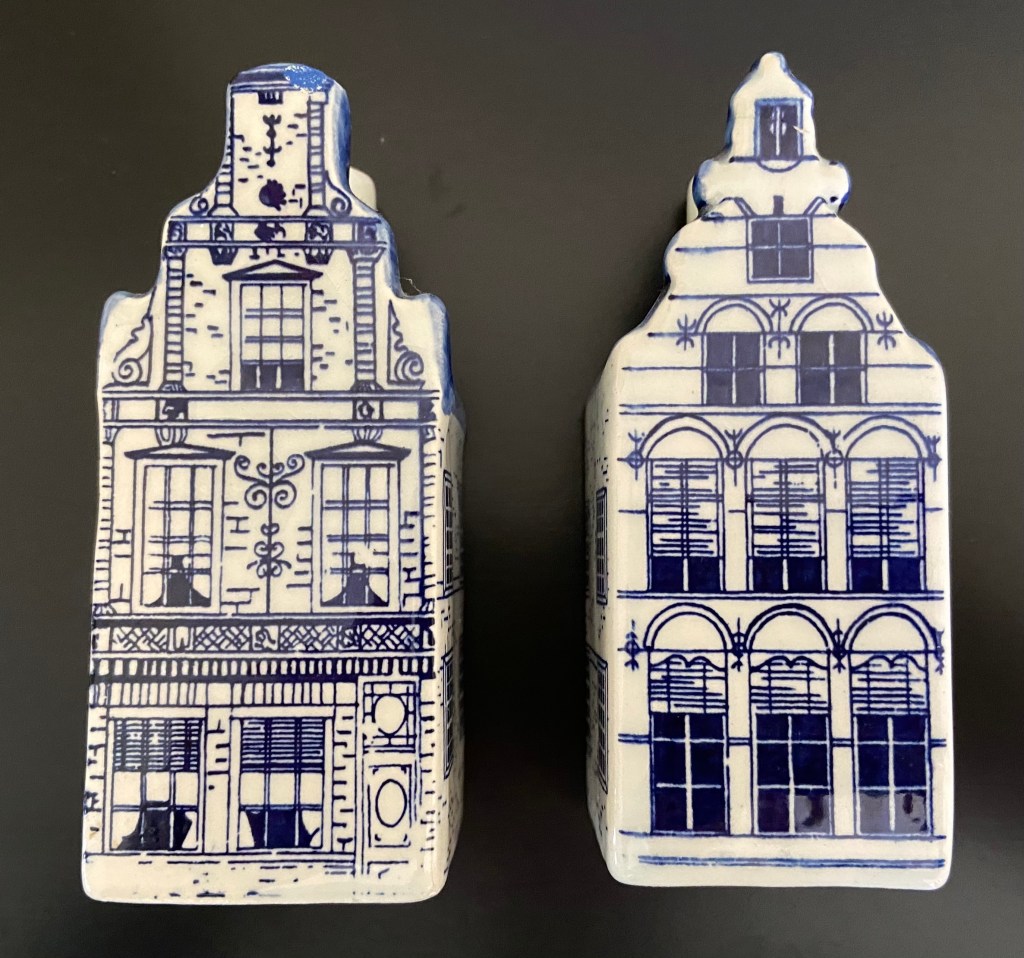
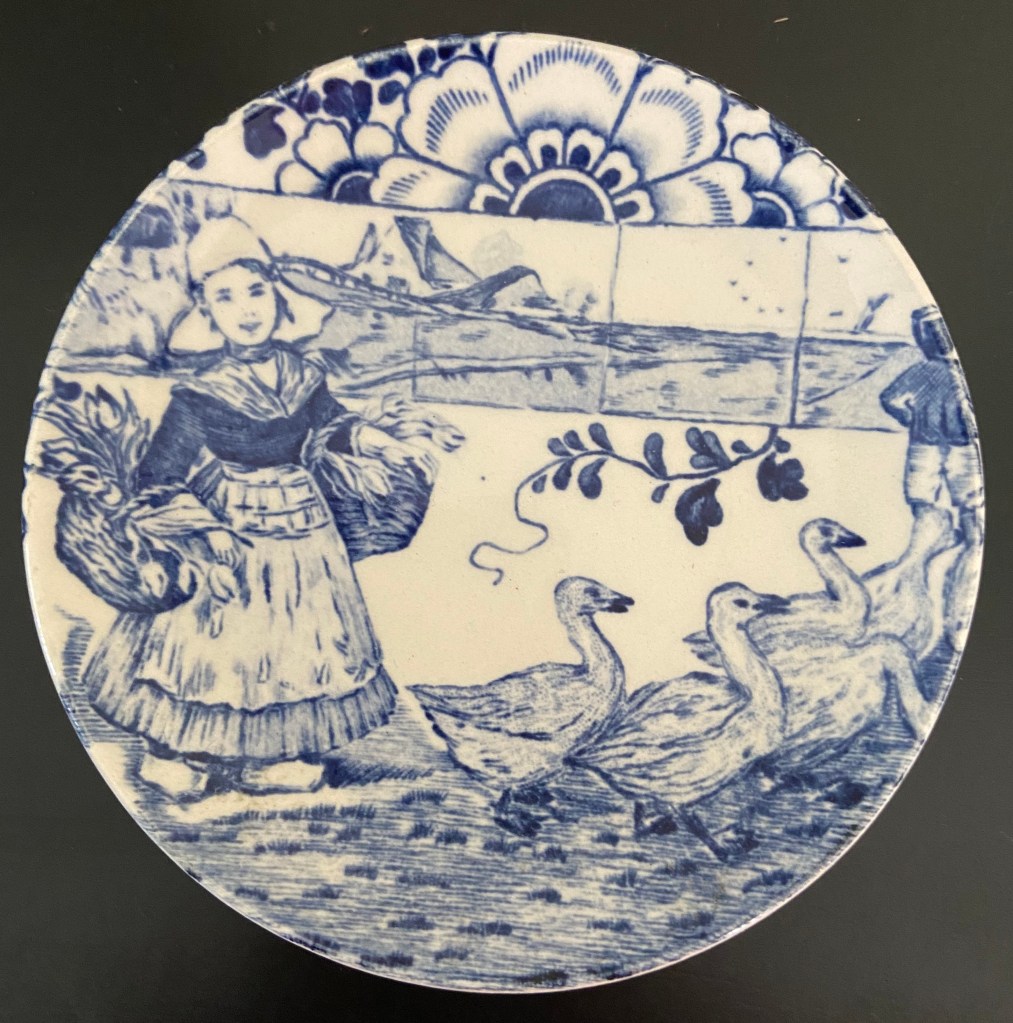
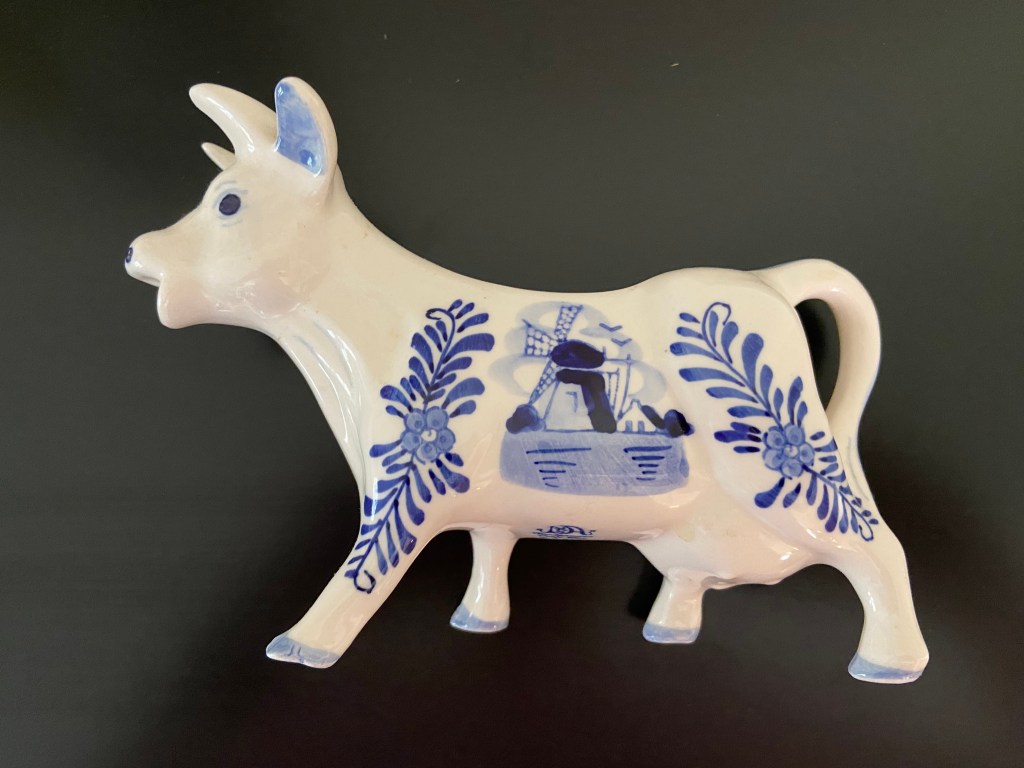
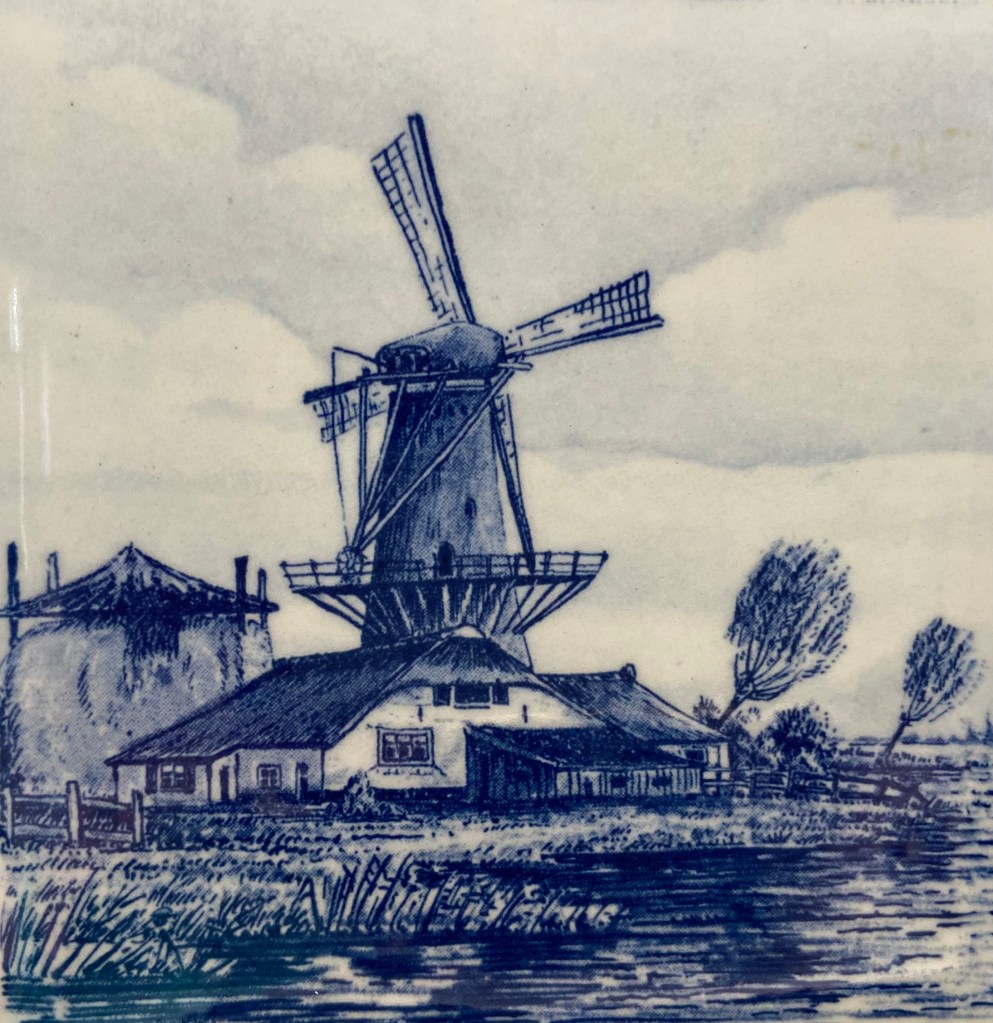
But I must admit that my favorite pottery is the blue and grey Flemish stoneware that predates Delft. Decorated with cobalt blue designs and salt glazed, these are the kind of pots that would be used in humble kitchens throughout the low countries. My Flemish ancestors in the farmland around Ghent may not have owned any expensive Delftware but they would have had blue and grey pots for everyday use. The gift shops in Ghent are full of the traditional pots, many still used to store mustard.
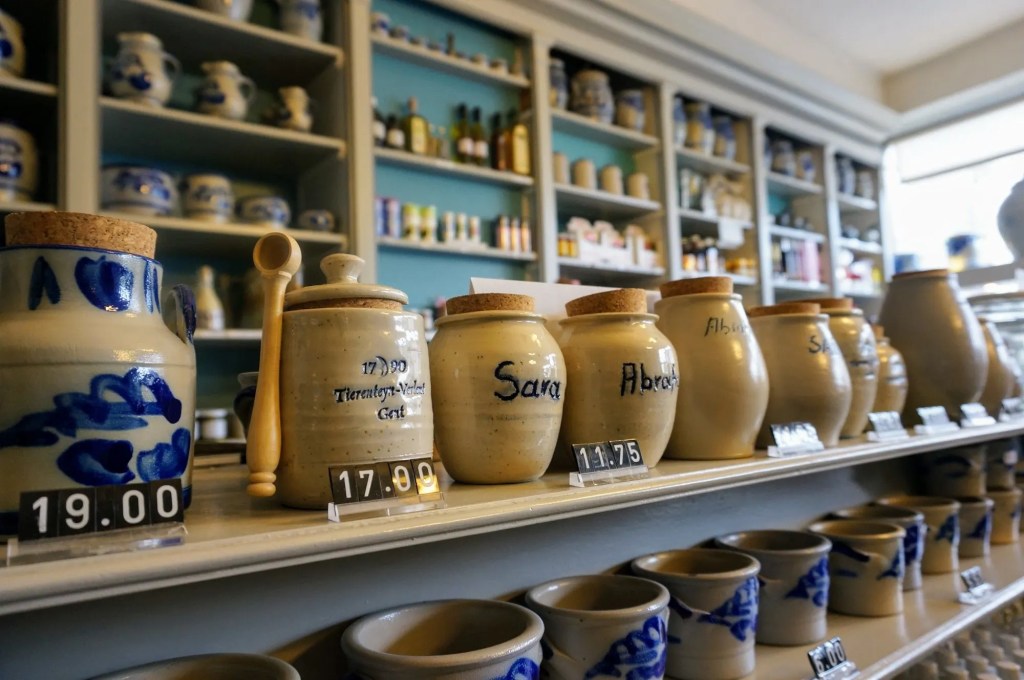
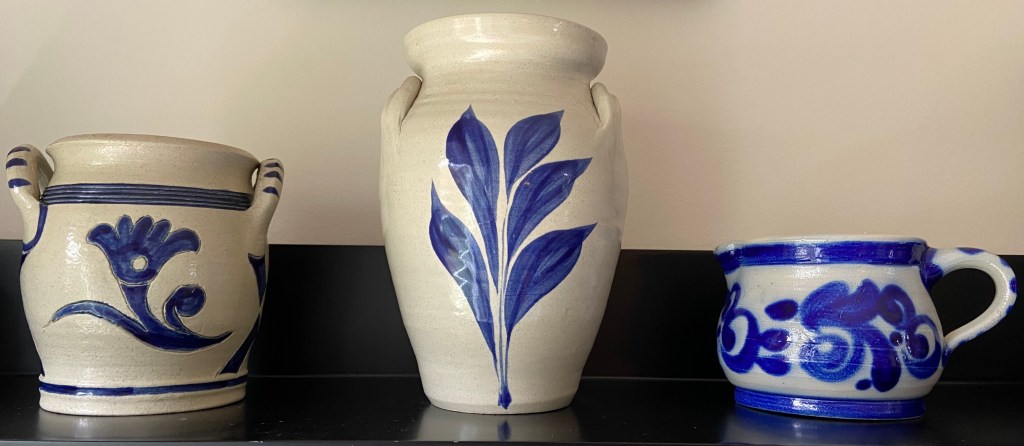
I don’t think I’ve ever visited Ghent without picking up at least one of these pots:
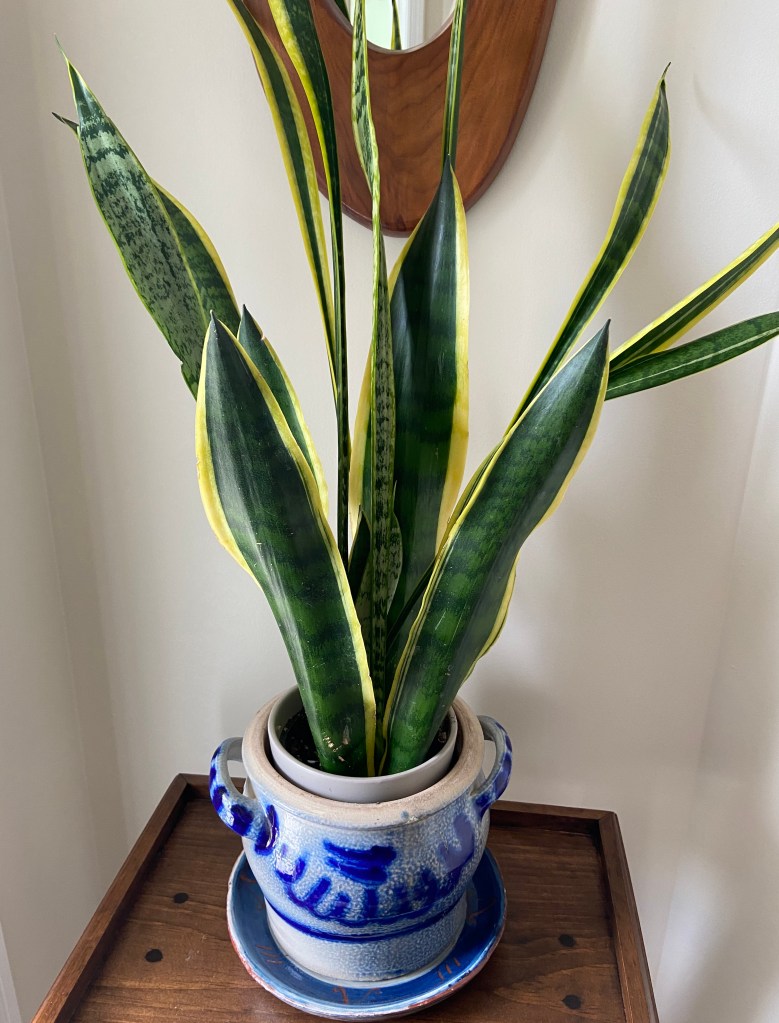
My favorite Flemish pot contains a sansevieria plant. In my childhood these plants were seen in the front windows of houses everywhere in Ghent, often backed by lace curtains. My grandmother had one in a pot just like mine. She called the plant by the wonderful Flemish name vrouwentong which means mother-in-law’s-tongue.
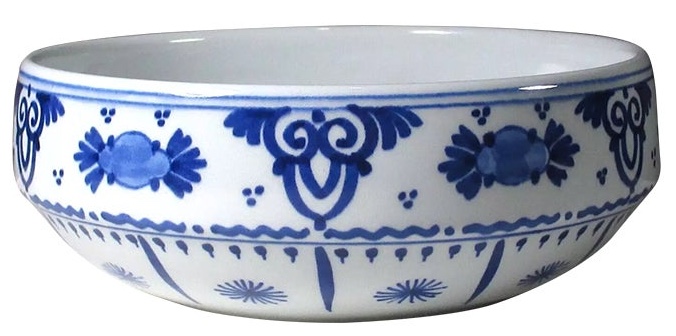
To circle back to Genevieve Wheeler Brown’s book, she continues the tale of Delftware into the eighteenth century’s booming ceramics trade when Delft faced many competitors, and on to the Gilded Age and the wealthy New York women whose passion for collecting Delftware matched that of Queen Mary II’s. What explains the unique appeal of blue and white she asks?
Together, blue and white create a pairing of unparalleled vibrancy. Each color is individually attractive, but together their tones harmonize – the depth of blue magnified by the contrasting lightness of white. Whether in nature, with a clear sky dotted by cumulus clouds, or crafted by human hands in a potter’s studio using cobalt and tin extracted from beneath the earth’s surface, this duo’s power is undeniably mesmerizing. The combination of blue and white remains timelessly and universally appealing.


My late wife Jenny came from a long line of Staffordshire potters, so I was interested to read about Delft pottery. I thought there might be a connection, but couldn’t find one.
LikeLiked by 1 person
What a fantastic post! I learnt so much! And I have a little set of those ceramic clogs from my grandmother! Linda xx
LikeLike