Dear Readers: I was SCOOPED by The Washington Post! I had almost finished writing this when I opened the paper one morning and saw an article on the front page of the Metro section about the carillon tower in Baker Park, Frederick. Quite a coincidence! But I wrote mostly about Belgium so I just decided not to go on at length about the Frederick tower and refer you to the Post instead. It is a great article, though it omits the Belgian connection.
In 1626 Francesco Belli, traveling with Italian Ambassador Giorgio, wrote home from Flanders:
The bells in these countries serve for music; their timbre is so sweet and their harmony so complete that they express and include all the notes of the voice.
Two hundred and fifty years later Robert Louis Stevenson and a friend traveled through Belgium by canoe following the rivers and canals from town to town. In his account of the journey, An Inland Voyage, he recalled their starting point in Antwerp:
On the other side of the valley a group of red roofs and a belfry showed among the foliage; thence some inspired bell ringer made the afternoon musical on a chime of bells. There was something very sweet and taking in the air he played and we thought we had never heard bells speak so intelligently or sing so melodiously as these.
These are just two of the awed travelers who recorded their impressions of Flemish bell towers in diaries, letters, memoirs, and travel books from medieval times to our own day. One dubbed the region “The Land of Singing Towers,” another described journeying through Belgium as following “a chain of melody.”

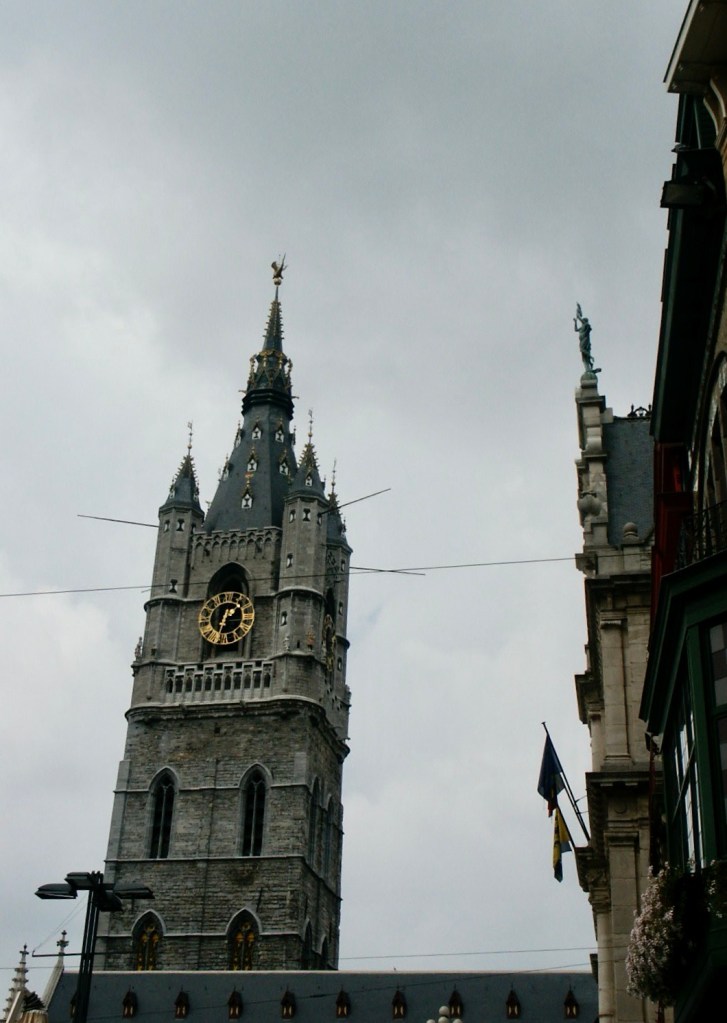
I confess my earliest memory of the belfry in Ghent, my mother’s home town, is not the sound of bells but the fearsome sight of the dragon that dominates a lower chamber in the tower. It is the original gilded copper dragon that was installed atop the tower in 1378. He guarded the town for hundreds of years until he was replaced in 1853.

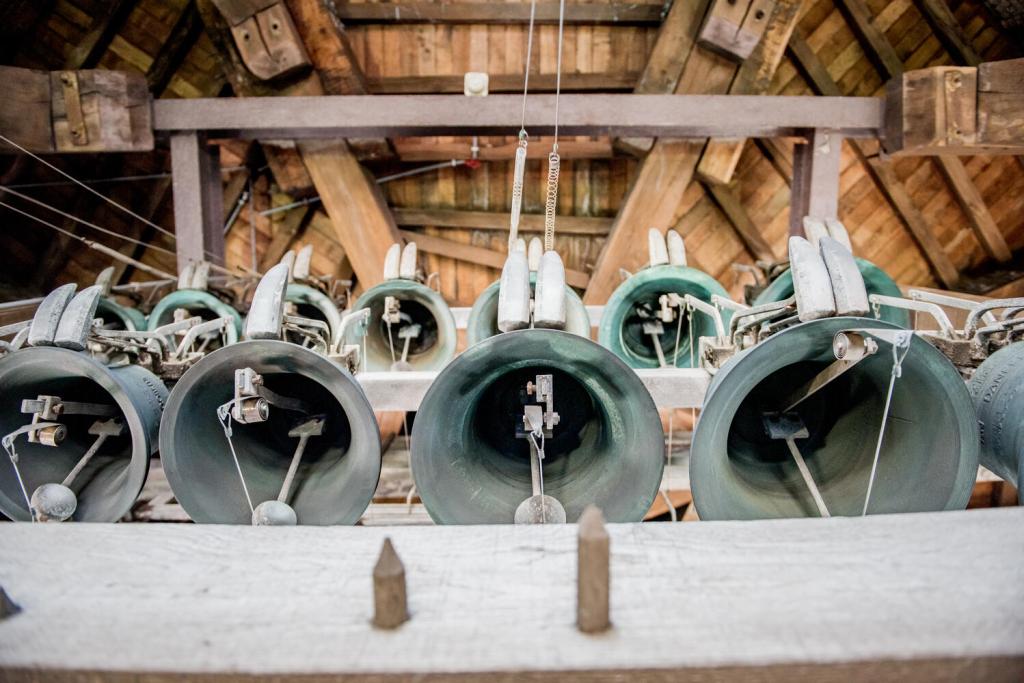
The bell music that so captivated travelers in Flanders is not made by a team of ringers pulling on long ropes. For the art of change ringing I refer you to Dorothy Sayers’ mystery novel The Nine Tailors. The bells of Flanders do not swing back and forth, they chime when struck by hammers. This carillon music can be played in two ways. Automatically by a revolving drum (in Flemish a speeltrommel) that works like a giant music box. Pins inserted in holes in the drum trip levers connected to hammers which strike the outside of the bells. Tunes can be programmed by arranging the pins. Or a skilled musician called a carillonneur plays the bells by a keyboard or clavier like a giant organ. In this case the inside of the bells are struck.
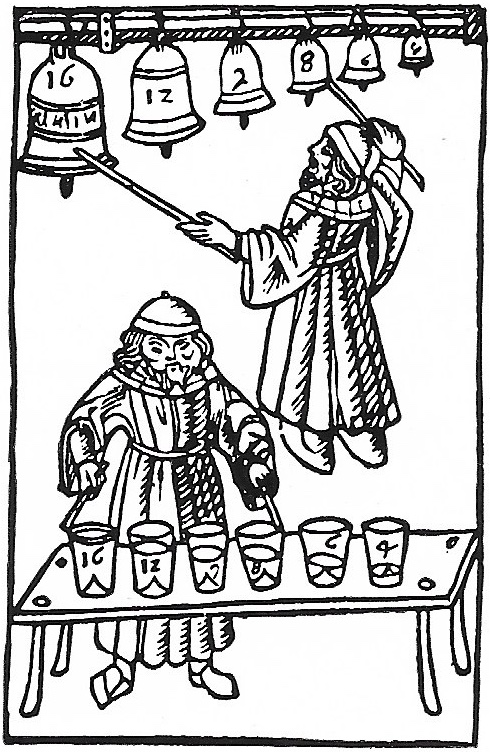
The art of bell founding and carillon music developed over many centuries. Construction of the Ghent Belfry began in about 1300. The original purpose of these towers in Flanders was to serve as an alarm of invasion or other calamity. The bells became an integral part of medieval life, rung in religious processions, Guild parades and celebrations of all kinds. Then clockwork mechanisms were added so the bells chimed the hours, often not very accurately. In Ghent a wooden clockwork mechanism was added to the fifty-two bells in 1378 and in 1553 the first clavier was connected. The seventeenth century flowering of art and culture in the low countries was also a Golden Age for carillon music. The master bell founder Pieter Hemony recast Ghent’s bells in 1659, and though there have been many changes in the years since, thirty-seven of his bells survive.
The largest bell in Ghent was named Roland. Installed in 1314 it was 82.67 inches in diameter and weighed six tons. Roland was inscribed with these words in Flemish:
When I clap there is fire and when I toll there is victory in the land.
Roland is perhaps the only bell ever punished by an emperor. When Charles V subdued a revolt by the people of Ghent in 1539 he ordered the bell silenced because…
Roland was convicted of having played a very turbulent part with its tongue.
But Roland lived on. It was recast by Pieter Hemony in 1659 and remained in the carillon until 1914 when it developed a crack. It was replaced and the original is now displayed near the belfry,

A folk song was dedicated to Roland in 1877 based on a poem by Albrecht Rodenbach with music by Johan Stoop. It became a popular anthem for Ghent. These are the first and last verses translated from the Flemish:
Above Ghent rises, lonely and greyed,
the old belfry, symbol of the past
Somber and great, always mute and dead,
the old giant sorrows over today’s Ghent
But sometimes he sounds and suddenly shouts
his bronze voice through the city.Flanders the Lion! Sound, old tower!
And pair your song with our choirs.
Sing “I am Roland, I sound fire!”
Loud triumph in Flanders!
I collect old books about Flemish history and Ghent and I have several about the celebrated bells.
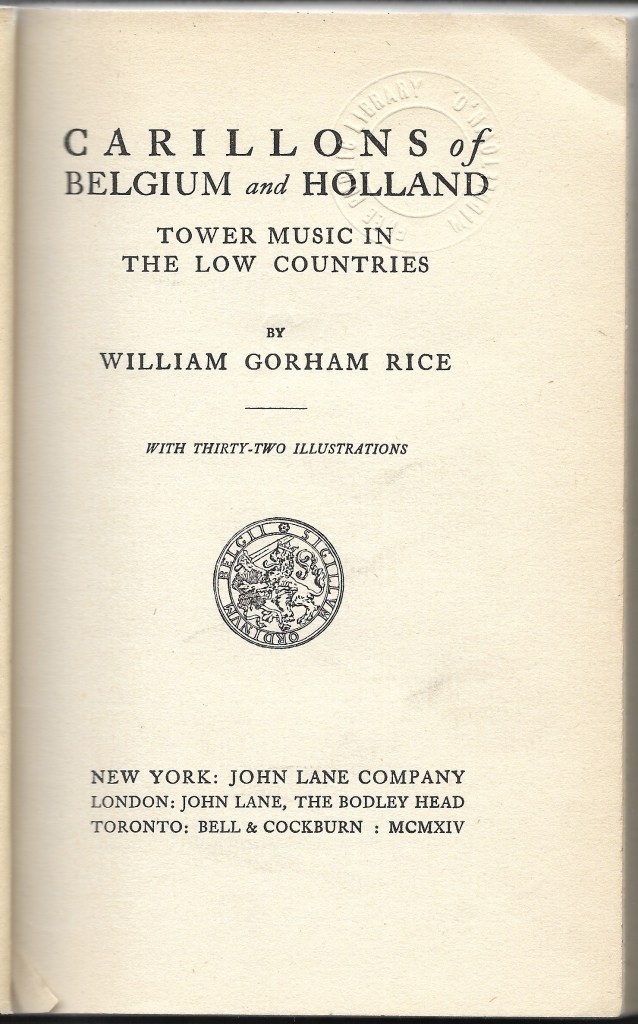

Vanished Towers and Chimes of Flanders published in 1916 is a lament for the towers damaged or destroyed in the First World War. In both World Wars the German forces seized bells to melt down for munitions. During the Nazi occupation about two thirds of Belgium’s bells were taken. The Flemish retaliated with a defiant slogan:
Wie met klokken schiet (He who shoots with bells)
Wint den oorlog niet. (Does not win the war).
After the war many of the bells were recovered from so called “bell graveyards” in Germany. And in time the famous towers were repaired and their bells restored or replaced.
On first visiting Frederick, Maryland, I was surprised to find that the city boasts a tower carillon of its own. Unlike its European forbears the tower sits isolated in the middle of parkland instead of nestled in amongst medieval buildings. It gives the impression of a lone sentry standing watch.
More surprising still I learned that the carillonneur, John Widmann, spent a year at the Royal Carillon School in Mechelen Belgium. An ancient Flemish art lives on in our community.
For more on the Frederick carillon and its dedicated carillonneur I refer you to the article in the Washington Post.


 Dispatches From the Former New World