
The Tudor Autopen

Henry VIII’s signature

On 30th December 1546 King Henry VIII lay dying, bloated beyond recognition and in excruciating pain from a festering wound on his leg, the result of a jousting accident years before. When his councillors brought him the final revision of his will he was too weak to hold a pen. So the document was signed using the dry stamp, a Tudor version of the autopen which has become so controversial recently. The dry stamp was a mechanism screwed onto paper to make an impression of the king’s signature, which was then inked over by one of his officials. Henry had authorized the use of this device in 1545 as his infirmities grew more severe.

Jefferson’s Polygraph Machine

Our current autopen issue is just another of the baseless scandals “trumped” up by President Trump and his acolytes to serve his interests. If autopen signatures on the pardons issued by President Biden can be declared invalid, then Trump is free to charge all his enemies with imaginary crimes. In fact many presidents as far back as Thomas Jefferson, including Trump himself, have used some type of autopen to sign official documents. Jefferson called his Polygraph Machine “the finest invention of the present age.” Richard Nixon, Lyndon Johnson, John F. Kennedy, and many other presidents routinely used an autopen. The question of its legality was definitively answered during the George W. Bush presidency in a 2005 memo from the Office of Legal Counsel. The challenge to Biden’s autopen signatures is unlikely to change history. But the case of Henry VIII’s will was of far more consequence for the history of the English monarchy.

Henry’s complicated marital history and mercurial temperament had necessitated passing three different Succession Acts during his reign. The first two disinherited his daughters Mary and Elizabeth, declaring them illegitimate because his marriages to their mothers Catherine of Aragon and Ann Boleyn were invalidated, by divorce and treason respectively. The third Succession Act of 1543 named Edward, his longed for son by third wife Jane Seymour, as his heir. Mary and Elizabeth were declared legitimate after all and reinstated to the succession order if Edward died childless. If all three should die childless, an unlikely outcome that would actually come to pass, then the succession should follow Henry’s last will. The act included the fateful language that the succession order in his will would be valid if “signed with his most gracious hand.”

Continue reading “The Tudor Autopen”

Charlotte Bronte and Elizabeth Gaskell

I first read Elizabeth Gaskell’s Life of Charlotte Bronte when I was a teenager, newly enraptured by the Bronte sisters’ novels and the romantic bleakness of the Yorkshire moors. I remember the spell cast by the opening chapter as Gaskell takes us on her journey to visit Charlotte in Haworth. It is as though the reader is her companion on the Leeds and Bradford railway line to Keighley, then by carriage four miles to Haworth, past farms and workmen’s cottages and up the steep hill to the church, the parsonage, and the graveyard “terribly full of upright tombstones.” Gaskell, herself a novelist, paints an evocative picture of the landscape and atmosphere. We hear the horses’ hooves slipping on the paving stones of the steep street and breathe the “dim and lightless” air full of smoke from the clustered chimneys. I hadn’t read many biographies before and had expected it to start with Charlotte’s birth. I was so impressed with this way of leading the reader first into the world of the subject that my young self decided all biographies should be like this, that Elizabeth Gaskell had set the standard by which all others should be judged. It was one of the most memorable reading experiences of my life.

On publication in 1857, two years after Charlotte’s death, the Life was an immediate bestseller and has remained in print ever since, considered a classic of biography. What I did not know until recently, when I read a new book on the subject, is that on first publication Gaskell’s Life faced a storm of controversy causing major problems for the author and publisher.

Continue reading “Charlotte Bronte and Elizabeth Gaskell”

Jane Austen’s Favorite Authors

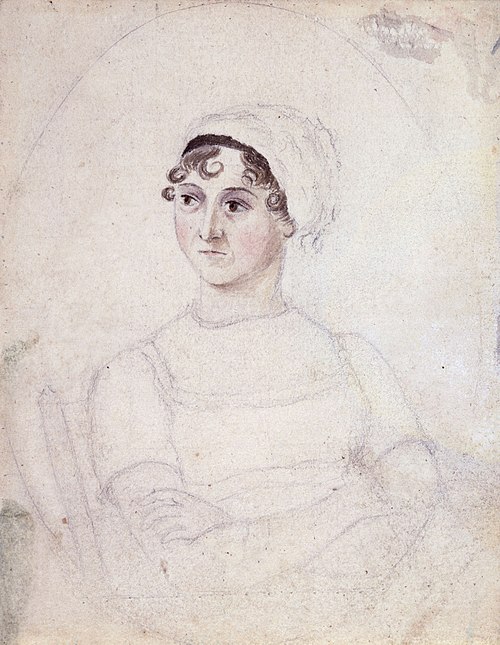
Portrait of Jane Austen by her sister Cassandra

Almost everyone reads Jane Austen at some point in their lives, but what did Jane herself like to read? She left plenty of clues in her own books. Many of her characters express their opinion of books in a way that gives us insight into their personalities. For instance in Northanger Abbey Catherine Morland, about to imagine herself the heroine of her own Gothic adventure, declares:

I have read all Mrs. Radcliffe’s works, and most of them with great pleasure. The Mysteries of Udolpho, when I had once begun it, I could not lay down again; I remember finishing it in two days — my hair standing on end the whole time.

There are further clues in Austen’s letters to friends and family, who often exchanged opinions on the authors of the day. Austen even used the opinion of a book as a test of character. In a letter to her sister Cassandra Fanny Burney’s novel Camilla is the test for one new acquaintance:

There are two Traits in her Character which are pleasing; namely she admires Camilla, & drinks no cream in her Tea.

In Jane Austen”s Bookshelf rare book collector Rebecca Romney follows these clues in a quest to find and read books by Austen’s favorite authors. She hunts for editions that date to Austen’s lifetime and has a book expert’s eye for beautiful bindings, which she describes in loving detail. And to her surprise she thoroughly enjoys most of these books, finding them worthy of sitting alongside Austen on her bookshelf. Her reading raises a question: why have these women authors been mostly forgotten, while Austen is remembered as the only great woman writer of her time, the only one worthy of inclusion in the Canon of enduring classics? Romney finds answers in the writings of nineteenth and early twentieth century literary critics, almost all male. 

As I read about these authors and their books I began to compile my own reading list for the rest of the summer; The Mysteries of Udolpho is already downloaded to my Kindle. But I found the life stories of these women as compelling as any novel, and marveled at their ability to write despite the sometimes shocking travails they endured.

Meet Jane Austen’s favorite authors:

Frances Burney (1752-1840)

Frances Burney began writing as a teenager and published her first novel, Evelina, in 1778. It is a coming-of-age story of an orphan girl who leaves the countryside for London and her experiences there in the search for happiness. Evelina follows the tradition of Samuel Richardson’s Pamela (1740) and Henry Fielding’s The History of Tom Jones (1749) but is distinguished for its emotional complexity and vivid portrayal of the heroine’s interior world. The book was an immediate sensation. Even the king and queen read it. Samuel Johnson, the most famous literary critic of the day, said he could recite entire scenes from memory and declared “Henry Fielding never did anything equal.” It was from Burney’s second novel Cecilia that Austen borrowed the phrase Pride and Prejudice. Rebecca Romney tracks down the exact sentence:

Continue reading “Jane Austen’s Favorite Authors”

Kings and Commonwealth: a concert for our times

Does a concert of 16th and 17th century music have any relevance to our present moment?

The last thing I could have imagined as I sat in my high school classroom laboring over a test about the Rump Parliament was that decades in the future, in a far country, I would attend a concert featuring a ballad about the Rump Parliament. The Rump Parliament you ask? Well it’s one of those obscure English history topics like rotten boroughs or Lambert Simnel that you would be expected to know about for an exam. Hearing the popular ballads of the time would certainly have made it more interesting.

Long before newspapers, magazines, and media, street ballads were a form of political commentary and satire. The Folger Consort drew on these sources for their May concert Kings and Commonwealth, music of the English Civil War. 

The program began with a Tudor Prelude, a reminder that it was the excesses of tyrannical kings that led to the Civil War. By chance I had just watched the final episode of Wolf Hall: The Mirror and the Light ending with Thomas Cromwell’s execution. Now I was treated to a broadside ballad celebrating his demise. Hilary Mantel created a sympathetic portrait of Cromwell in her novels. But at the time of his death Cromwell was a despised figure, hated for confiscating the wealth of the monasteries to enrich the king and himself, and for turning away from the Catholic faith. These themes come up in the ballad Trolle on Away, as well as distain for his humble origins.The meaning of the word trolle is obscure but may be related to a Middle English word for rolling or trundling an object, suggesting dragging Cromwell to his fate. 

Continue reading “Kings and Commonwealth: a concert for our times”

Springing a Surprise

My garden has been full of surprises this year. We moved into our new house in November when the garden was settling in for winter, all bare branches and withered plants, the beds choked with leaves. We had no idea what would emerge in spring. 

First came the daffodils, several different varieties, popping up in random spots all over the yard. “She loved flowers but she just stuck them anywhere,” said a neighbor darkly about the previous owner. Well, perhaps that adds to the charm. Certainly to the surprises.

Next came the clumps of grape hyacinth and candytuft painting a blue and white palette across the side yard. 

Continue reading “Springing a Surprise”

The Bells of Belgium… and Frederick, MD

Dear Readers: I was SCOOPED by The Washington Post! I had almost finished writing this when I opened the paper one morning and saw an article on the front page of the Metro section about the carillon tower in Baker Park, Frederick. Quite a coincidence! But I wrote mostly about Belgium so I just decided not to go on at length about the Frederick tower and refer you to the Post instead. It is a great article, though it omits the Belgian connection.

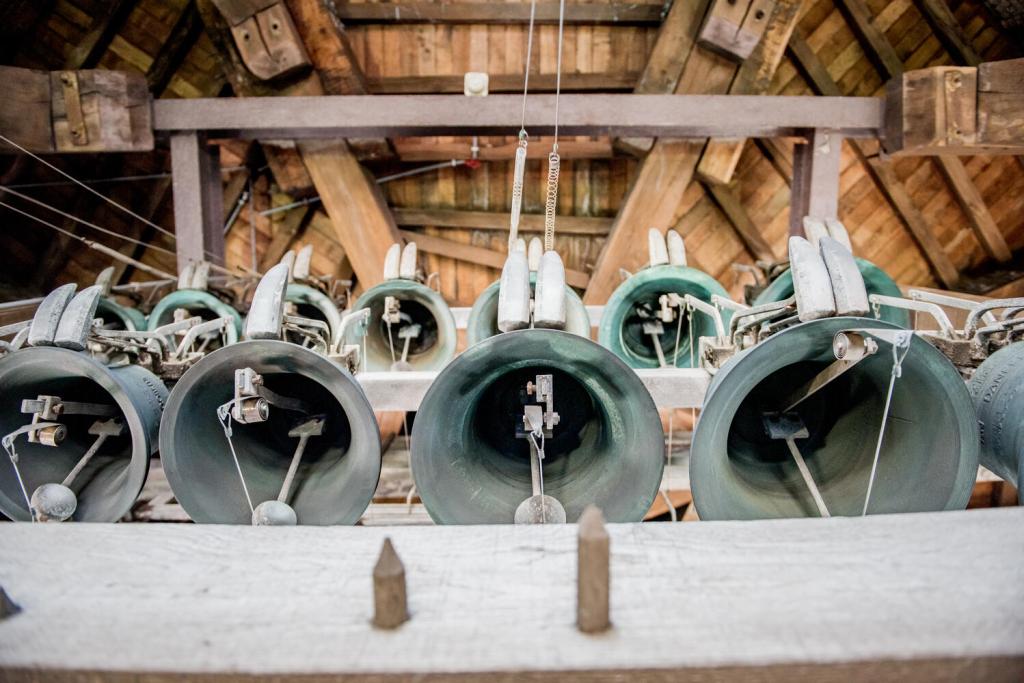
Bells in the Ghent Belfry

In 1626 Francesco Belli, traveling with Italian Ambassador Giorgio, wrote home from Flanders:

The bells in these countries serve for music; their timbre is so sweet and their harmony so complete that they express and include all the notes of the voice.

Two hundred and fifty years later Robert Louis Stevenson and a friend traveled through Belgium by canoe following the rivers and canals from town to town. In his account of the journey, An Inland Voyage, he recalled their starting point in Antwerp:

On the other side of the valley a group of red roofs and a belfry showed among the foliage; thence some inspired bell ringer made the afternoon musical on a chime of bells. There was something very sweet and taking in the air he played and we thought we had never heard bells speak so intelligently or sing so melodiously as these.

These are just two of the awed travelers who recorded their impressions of Flemish bell towers in diaries, letters, memoirs, and travel books from medieval times to our own day. One dubbed the region “The Land of Singing Towers,” another described journeying through Belgium as following “a chain of melody.”

Continue reading “The Bells of Belgium… and Frederick, MD”

Adventures in Unreal Estate

Last summer I fell down a rabbit hole into the topsy-turvy world of Unreal Estate. It would be more accurate to say I jumped down the rabbit hole. It was sudden and impulsive but it had been a long time coming. And, appropriately for a librarian, it all happened because of a bookcase. Let me explain.

My daughter is a nurse who works with the elderly. She has seen her share of falls or sudden illness crushing a senior’s quality of life. A three storied house with steep stairs was no place for us as we aged she insisted, and we resisted. Every now and again she would send me a listing for a house for sale in Foxfield Village, a senior community near her home in Middletown. It would be perfect, she claimed, single level living and so near the grandchildren. 

Quite an inducement. But there was always something wrong with the house. One seemed quite nice on the inside but the yard was a blank expanse of lawn, front and back. Not a twig or a leaf of any kind to be seen. How could I leave my garden full of flowering trees and shrubs and perennials for this sad bleak plot? There was always something. We had upgraded to stainless appliances, how could we go back to old white ones? My younger self would be appalled at my design snobbery. But I admit to it. We don’t always become better people as we age.

Then one Thursday last August she sent a listing that seemed to check all the boxes. Small but pretty garden, stainless appliances, and a glass enclosed porch, perfect for my heat and insect intolerance. There was just one problem. The open plan living space didn’t seem to have a wall long enough for my bookcase. I pored over the photos in search of an angle that would show a wall. None appeared. This was a nonnegotiable. 

Continue reading “Adventures in Unreal Estate”

My Favorite Reading of 2024

My bookcase made a successful transition to my new house

FICTION

Caledonian Road by Andrew O’Hagan.
How could I resist a book billed as the Dickens of contemporary London? It did not disappoint. The city itself is a main character and according to the GuardianThe London that emerges from its 600-odd pages resembles a vast, rotting carcass picked over by carrion.” That doesn’t sound very appealing, but the book is constantly entertaining and mordantly witty. The central character is middle aged writer and academic Campbell Flynn who rose from humble beginnings to celebrity, but whose life is now spiraling out of control. Around him swirls a cast of characters high and low, from aristocrats to human traffickers, working class students to Russian oligarchs. We can’t help but root for the hapless Campbell as he is snared in a plot of corruption and scandal he can’t escape. The usual suspects of the English class system and hypocritical politicians get a merciless drubbing.

Creation Lake by Rachel Kushner.
Like Birnam Wood, on my favorites list last year, Creation Lake is about a radical environmental group, this time in rural France near a cave where Neanderthal remains were discovered. But unlike the gardening collective of that novel, Le Moulin plans violence. An American spy-for-hire, a woman using the undercover name Sadie, infiltrates the group. Kushner successfully combines the suspenseful plot of a thriller with a serious novel of ideas. Sadie becomes fascinated with letters from Bruno, a legendary activist who inspired the founders of Le Moulin. He believes that Neanderthals had a superior way of life, in harmony with nature, and that Homo Sapiens has gone tragically astray. Is Sadie’s mission to disrupt Le Moulin’s violent plans or to entrap them by urging them on? Where do her true loyalties lie? This novel was deservedly short-listed for the Booker Prize.

Continue reading “My Favorite Reading of 2024”

The Night Before Christmas 2024

The Dispatches have been on hiatus from late summer into winter as I downsized to senior living and hurtled down a rabbit-hole into the topsy-turvy world of Unreal Estate. More on that before long. But I was dragged out of my hibernation by a need to sublimate the horror of November and dread for 2025 . The result is another in my rewrites of The Night Before Christmas.

’Tis the night before Christmas
When all through D.C.
The Deep State is worrying
How to save democracy.

While down in Mar-a-Lago
Trump’s transition team
Plots Revenge and Retribution
On all who’ve been mean.

Continue reading “The Night Before Christmas 2024”

On Thin Ice

Just after New Year in 1984 a freak ice storm at evening rush hour paralyzed traffic in Montgomery County. Within seconds the wet roads froze into slick ice skating rinks. Nothing could move for hours. Into this chaos stepped the usual first responders, but also, perhaps surprisingly, librarians. All across the County stranded motorists sought refuge in those most welcoming of places, the public libraries.

Recently the retired librarians email group featured a thread of memories of that long ago night. I remember it well. At the Gaithersburg Library drivers abandoned their cars on Montgomery Village Avenue and precariously picked their way across the ice into the library. We didn’t close. We were trapped for hours. My small children were home with my mother so at one point I tried to leave. I didn’t get far from the back door when I could go no further. I was on my hands and knees and then stranded on a tiny ice-free oasis, unable to get to my car or return inside. I was stuck there for about an hour, freezing cold and feeling rather ridiculous. Eventually a police officer drove up and rescued me, helping me back into the library. Everyone was shocked to see me, thinking I was home long before. It wasn’t till about 1:00 in the morning that we were finally able to leave.

The next day, inspired by the story of the Andes plane crash survivors who resorted to cannibalism, I wrote a satirical account of the icy night that was published in The County Express newspaper on January 4th.

Continue reading “On Thin Ice”