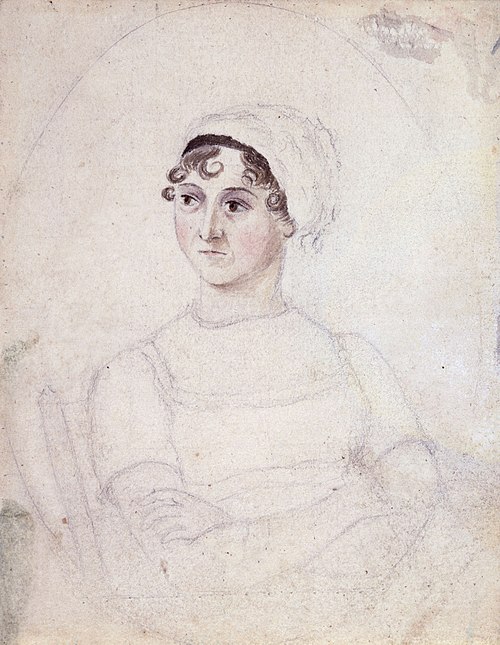
Almost everyone reads Jane Austen at some point in their lives, but what did Jane herself like to read? She left plenty of clues in her own books. Many of her characters express their opinion of books in a way that gives us insight into their personalities. For instance in Northanger Abbey Catherine Morland, about to imagine herself the heroine of her own Gothic adventure, declares:
I have read all Mrs. Radcliffe’s works, and most of them with great pleasure. The Mysteries of Udolpho, when I had once begun it, I could not lay down again; I remember finishing it in two days — my hair standing on end the whole time.
There are further clues in Austen’s letters to friends and family, who often exchanged opinions on the authors of the day. Austen even used the opinion of a book as a test of character. In a letter to her sister Cassandra Fanny Burney’s novel Camilla is the test for one new acquaintance:
There are two Traits in her Character which are pleasing; namely she admires Camilla, & drinks no cream in her Tea.

In Jane Austen”s Bookshelf rare book collector Rebecca Romney follows these clues in a quest to find and read books by Austen’s favorite authors. She hunts for editions that date to Austen’s lifetime and has a book expert’s eye for beautiful bindings, which she describes in loving detail. And to her surprise she thoroughly enjoys most of these books, finding them worthy of sitting alongside Austen on her bookshelf. Her reading raises a question: why have these women authors been mostly forgotten, while Austen is remembered as the only great woman writer of her time, the only one worthy of inclusion in the Canon of enduring classics? Romney finds answers in the writings of nineteenth and early twentieth century literary critics, almost all male.
As I read about these authors and their books I began to compile my own reading list for the rest of the summer; The Mysteries of Udolpho is already downloaded to my Kindle. But I found the life stories of these women as compelling as any novel, and marveled at their ability to write despite the sometimes shocking travails they endured.
Meet Jane Austen’s favorite authors:
Frances Burney (1752-1840)

Frances Burney began writing as a teenager and published her first novel, Evelina, in 1778. It is a coming-of-age story of an orphan girl who leaves the countryside for London and her experiences there in the search for happiness. Evelina follows the tradition of Samuel Richardson’s Pamela (1740) and Henry Fielding’s The History of Tom Jones (1749) but is distinguished for its emotional complexity and vivid portrayal of the heroine’s interior world. The book was an immediate sensation. Even the king and queen read it. Samuel Johnson, the most famous literary critic of the day, said he could recite entire scenes from memory and declared “Henry Fielding never did anything equal.” It was from Burney’s second novel Cecilia that Austen borrowed the phrase Pride and Prejudice. Rebecca Romney tracks down the exact sentence:
Continue reading “Jane Austen’s Favorite Authors” Dispatches From the Former New World