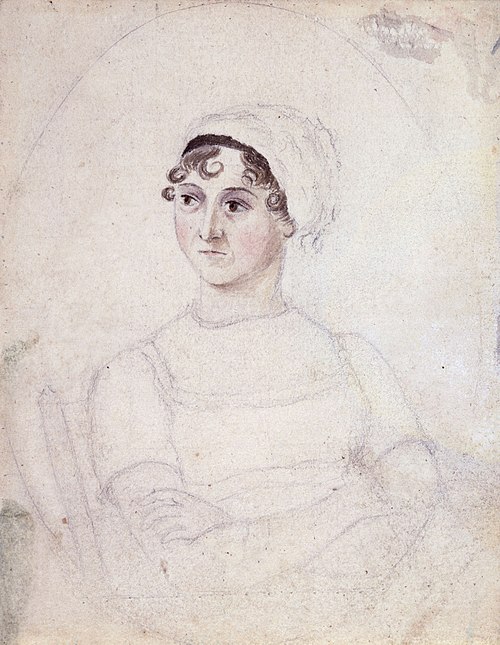
Almost everyone reads Jane Austen at some point in their lives, but what did Jane herself like to read? She left plenty of clues in her own books. Many of her characters express their opinion of books in a way that gives us insight into their personalities. For instance in Northanger Abbey Catherine Morland, about to imagine herself the heroine of her own Gothic adventure, declares:
I have read all Mrs. Radcliffe’s works, and most of them with great pleasure. The Mysteries of Udolpho, when I had once begun it, I could not lay down again; I remember finishing it in two days — my hair standing on end the whole time.
There are further clues in Austen’s letters to friends and family, who often exchanged opinions on the authors of the day. Austen even used the opinion of a book as a test of character. In a letter to her sister Cassandra Fanny Burney’s novel Camilla is the test for one new acquaintance:
There are two Traits in her Character which are pleasing; namely she admires Camilla, & drinks no cream in her Tea.

In Jane Austen”s Bookshelf rare book collector Rebecca Romney follows these clues in a quest to find and read books by Austen’s favorite authors. She hunts for editions that date to Austen’s lifetime and has a book expert’s eye for beautiful bindings, which she describes in loving detail. And to her surprise she thoroughly enjoys most of these books, finding them worthy of sitting alongside Austen on her bookshelf. Her reading raises a question: why have these women authors been mostly forgotten, while Austen is remembered as the only great woman writer of her time, the only one worthy of inclusion in the Canon of enduring classics? Romney finds answers in the writings of nineteenth and early twentieth century literary critics, almost all male.
As I read about these authors and their books I began to compile my own reading list for the rest of the summer; The Mysteries of Udolpho is already downloaded to my Kindle. But I found the life stories of these women as compelling as any novel, and marveled at their ability to write despite the sometimes shocking travails they endured.
Meet Jane Austen’s favorite authors:
Frances Burney (1752-1840)

Frances Burney began writing as a teenager and published her first novel, Evelina, in 1778. It is a coming-of-age story of an orphan girl who leaves the countryside for London and her experiences there in the search for happiness. Evelina follows the tradition of Samuel Richardson’s Pamela (1740) and Henry Fielding’s The History of Tom Jones (1749) but is distinguished for its emotional complexity and vivid portrayal of the heroine’s interior world. The book was an immediate sensation. Even the king and queen read it. Samuel Johnson, the most famous literary critic of the day, said he could recite entire scenes from memory and declared “Henry Fielding never did anything equal.” It was from Burney’s second novel Cecilia that Austen borrowed the phrase Pride and Prejudice. Rebecca Romney tracks down the exact sentence:
If to Pride and Prejudice you owe your miseries, so wonderfully is good and evil balanced, that to Pride and Prejudice you will also owe their termination.
Burney wrote two more novels, Camilla, Austen’s favorite, and The Wanderer. She also wrote plays and the journal she kept throughout her life was published, becoming a rich source for historians. Her personal life included difficult experiences. She endured a mastectomy for cancer without anesthetic, and in 1815 was a fugitive in Brussels as the Battle of Waterloo raged nearby. At the age of 41 she married a titled refugee from the French Revolution, many fled to England, and became Madame d’Arblay. Romney traces the critical reception of her work, which as time went on suffered from being constantly compared to Austen. But when she reads Evelina Romney is entranced.
Ann Radcliffe (1764-1823)

Ann Radcliffe had an unusual education. As a child she became the ward of her uncle Thomas Bentley, the artist who partnered with Wedgwood to create the designs on their ceramics. His house was filled with books and engravings of Gothic architecture and ornamentation which Ann pored over for hours. This is what gave her the inspiration for the ruined abbeys and haunted castles in her fiction, which she describes in chilling detail. She began to write out of boredom when her husband William was at work for long hours as a parliamentary reporter. When she read her terrifying scenes aloud to him he shuddered and she laughed! Her second novel A Sicilian Romance was described by Walter Scott:
Adventures heaped on adventures, in quick and brilliant succession, with all the hair-breadth charms of escape or capture.
Her third book The Romance of the Forest established her fame. The story of an orphaned heroine who seeks refuge in a ruined abbey it has all the tropes of the classic Gothic. “It has been the fashionable novel here, everybody read and talked of it” Maria Edgeworth wrote to a friend. By the time Radcliffe sold the manuscript of The Mysteries of Udolpho in 1794 she received 500 pounds, double the previous record for a woman writer. Readers reported staying up all night to finish it and one reviewer called it “the most interesting novel in the English language.” Its appeal has not dimmed. Romney reports that “Udolpho turned out to be one of the best reading experiences I have ever had.” Radcliffe sparked the Gothic boom in publishing with many imitators, often inferior, which eventually led to the genre being dismissed by critics.
But Radcliffe’s fall from grace came about in a different way. She just stopped publishing, and rumors circulated that she was dead. In fact she had purchased a country house with her earnings and lived there happily with her husband, enjoying many trips abroad. Instead of novels she wrote detailed accounts of her travels. Then the rumors took a dark turn. In 1810 poet Charles Wheelwright wrote:
Mrs. Ann Radcliffe, the ingenious authoress is reported to have died under that species of mental derangement, known by the name of the horrors.
In other words Radcliffe was stereotyped as a hysterical madwoman. When she actually died in 1823 her husband authorized a biography with excerpts from her travel writing, but facts could not dispel the rumors. Nevertheless Radcliffe was an important influence on the following generation of Romantics. Percy Shelley loved her novels and Byron even plagiarized her, copying a description of Venice for his Childe Harold.
Charlotte Lennox (1729-1804)
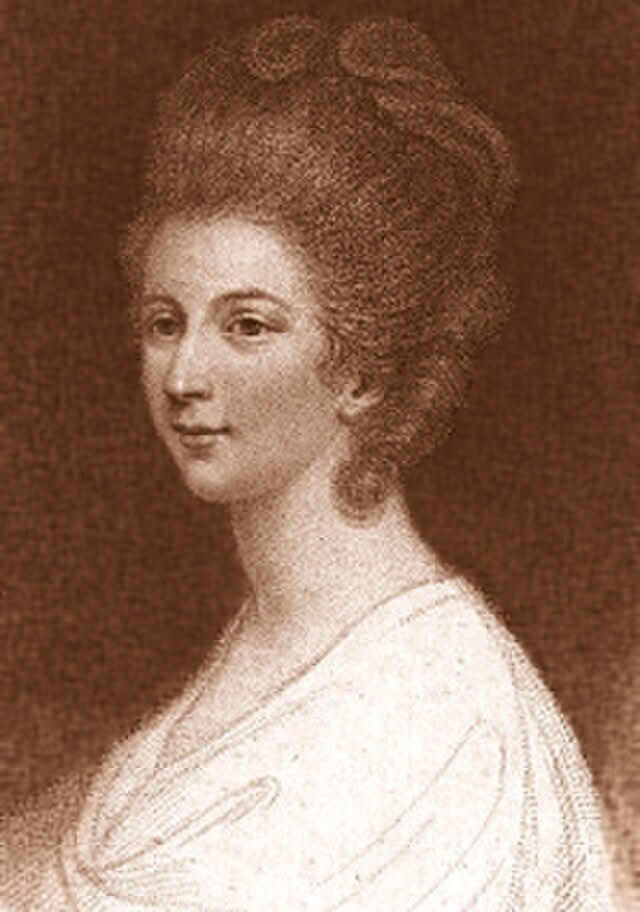
Charlotte Lennox spent part of her childhood in the colony of New York where her parents moved, but aged thirteen she was sent to live with an aunt in London. When she arrived she found the aunt was dead and shortly afterwards her father died. She was left penniless and alone and had to live by her wits, the plot of so many eighteenth century novels. Fortunately she was already a talented poet and was taken in by a series of aristocratic patrons. At eighteen she married Alexander Lennox who worked for her first publisher but had no wealth; Charlotte needed to write to make a living. The popularity of her first book of poems drew the attention of Samuel Johnson who threw a lavish party for her debut novel Harriot Stuart.
Her second novel The Female Quixote, a comic riff on chivalric romances, is the one that Jane Austen mentions reading more than once. It was a critical and a popular success. In a lengthy review novelist Henry Fielding found four points on which Cervantes was superior and five points on which Lennox was superior! Her heroine Arabella has wit and boldness, like Lennox herself. She dared to include a female character with a child out of wedlock, shocking at the time, which almost had the book pulled from publication. Her own life as a wife and mother was beyond reproach.
Lennox went on to shock her readers with a nonfiction work, Shakespear Illustrated, an investigation into the source materials for his plots. She was quite critical of Shakespeare, whose reputation was just on the rise, arguing that in many cases his source materials were superior. Shakespeare, she said:
Borrowed just enough to shew his Poverty of Invention, and added enough to prove his want of Judgment.
Samuel Johnson was thrilled, declaring Lennox had “demolished” Shakespeare. But this attack on England’s genius damaged her popularity and her later works were mainly translations. Romney dates her eclipse from the Canon to 1843 when an article in Gentleman’s Magazine claimed that the most famous philosophical chapter in The Female Quixote was actually written by Samuel Johnson. The story took hold and was repeated by critics through the years, though there is absolutely no evidence to support the claim.
Hannah More (1745-1833

Hannah More is the outlier among these authors as Austen didn’t exactly like her, but she read her work and had opinions. They all wrote at a time when novels were under attack by the gatekeepers of morality. In his Sermons for Young Women Rev. James Fordyce called novels “a horrible violation of all decorum” and their readers “carry on their forehead the mark of the beast.” Less hysterical objections included that “they excite a spirit of relaxation” and are so entertaining they become addictive. I imagine that criticism spurred many young women to reading them! More was raised in a strict religious household with a domineering father and in her first writings joined in the condemnation:
Novels nourish a vain and visionary indolence, which lays the mind open to error and the heart to seduction.
Then she wrote her own novel, Coelebs in Search of a Wife (the strange name is pronounced see-libs). Romney describes it as a courtship novel combined with a conduct book, prescribing correct behavior for virtuous young ladies. Coelebs woos a series of young women, rejecting each for their moral failures. Other characters are evaluated for their flaws and virtues, offering continuous lessons for the reader. Romney found it sanctimonious and unreadable, and I have not added it to my summer reading list. It was, however, wildly popular in its day.
Austen received a letter from her sister Cassandra recommending Coelebs, but she was dubious:
You have by no means raised my curiosity about Coelebs – my disinclination for it before was affected but now it is real. Of course I shall be delighted when I read it , like other people, but till I do, I dislike it.
Austen’s habit of using books as guides to her characters included More. In an unfinished work a prim aunt advises her misbehaving niece:
I had hoped to see you respectable and good. I bought you Blair’s Sermons and Coelebs in Search of a Wife.
Perhaps we should have some sympathy for More. She believed her father would disapprove of her writing if she did not include moral lessons and tried to appease him. She went on to write plays, poems, and essays with religious themes and devoted herself to charitable works. One critic called her the first Victorian.
Charlotte Smith (1749-1806)
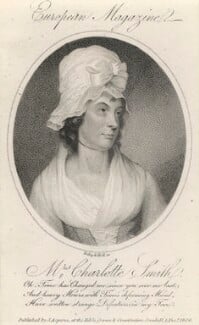
Charlotte Smith’s story is the one I found most compelling. She was a highly educated and brilliant woman who endured a very difficult life. Her mother died when she was three and her new stepmother despised her. Her father married her off at the age of fifteen to Benjamin Smith, son of a rich London merchant. But he turned out to be a complete wastrel, womanizer, and gambler and the couple were in constant financial distress. They even spent time in debtor’s prison together. Desperate to find some income to pay off her husband’s debts, Charlotte decided to try publishing the poems she had been writing throughout her life.
Elegiac Sonnets was published in 1784 and was so popular it went into a second printing immediately. Her work was hailed as “exquisite, their melody, feeling, and pathos touch the heart.” She was called the equal of Shakespeare, and later critics said her poetry belongs in the same breath as that of Wordsworth and Coleridge. Wordsworth was given a copy of Elegiac Sonnets in grammar school and later acknowledged his debt to her:
Smith is a lady to whom English verse is under greater obligation than are likely to be either acknowledged or remembered.
But poetry did not pay enough to get her husband out of prison or support their growing family of twelve children. So Charlotte turned to a more lucrative career, writing novels. How she did this with so many children I cannot imagine. In all she published eleven novels, three children’s books, and another book of poems. Her first novel Emmeline, the Orphan of the Castle was one of Austen’s favorite books; she read it as a teenager. Austen scholars have noted the influence of Emmeline on her work. It is the story of a neglected orphan girl who grows up on a crumbling estate. Her uncle visits bringing his son Delamere, an obnoxious spoiled brat, who falls in love with Emmeline. He pursues her for years across several countries as she continues to reject him. In the end Emmeline finds happiness with a man she loves. It was a departure from tradition to allow a heroine to have agency over her own choice of husband. Emmeline’s companion on her travels is a Mrs. Stafford, who seems based on Charlotte herself. She has a husband with “a temper growing more irritable in proportion as his difficulties increased ” to whom she was married at fifteen.
Charlotte’s troubles with Benjamin only became worse when he was released from prison. To escape more creditors he fled to France in 1784 and insisted that Charlotte and their nine surviving children join him. She made the voyage alone, seven months pregnant with their twelfth child, and with “so many little beings clinging about me, the youngest whom I bore in my arms scarce two years old.” When they arrived at the harbor Benjamin was not there to meet them as promised. Charlotte had to arrange transportation to the isolated castle he was renting from gambling friends. In another foolish enterprise he had invested in canaries, hoping to breed and sell them. He was so concerned for the welfare of the birds he could not leave them to meet his family!
This was a last straw for Charlotte who returned to England and began the complicated legal process of extricating herself from her marriage. Given the state of women’s rights at the time Benjamin still had financial control of her earnings and got half her small family inheritance. After her second novel was published in 1789 she wrote to a friend:
It really is almost too much for me to be compelled to live only to write & write only to live.
Only one of Smith’s novels became a classic, The Old Manor House, about a young man whose inheritance of the estate is jeopardized when his wealthy aunt disapproves of his choice of wife, a woman of a lower class. Romney is surprised to find that this novel too includes the phrase “pride and prejudice.“
Elizabeth Inchbald (1753-1821)

Elizabeth Simpson was a farmgirl from Suffolk who at the age of eighteen declared she “would rather die, than live any longer without seeing the world,” and ran away alone to London. Uneducated but beautiful and ambitious she would become an actress and celebrated playwright. Shortly after arriving in London she married an older actor, Joseph Inchbald, and they began an itinerant life touring with a theater company. In 1779 Joseph died suddenly and Elizabeth was left to make her own living. She used her contacts from her time with Inchbald to secure better acting jobs, finally being hired at Covent Garden and the Haymarket in London. Her acting skills were limited, but her beauty and hard work secured her small parts. Her real ambition and talent lay in writing. She began submitting drafts of plays and receiving rejections, but persevered.
Finally in 1784 her first play was accepted at the Haymarket, but the manager kept her authorship a secret until he saw if the play would succeed. The Mogul Tale was a farce about a group of Londoners in a hot-air balloon who have been blown off course into the territory of a Middle Eastern ruler. She played the part of one of the Mogul’s concubines. The opening night was a smash hit and Inchbald ran into the actor’s quarters overcome with joy, which confused them.
Had she an affection of the brain and this was a paroxysm, or was it some great aunt had died and left her a large fortune, or was she about to be married, or had she captivated the heart of some dear swain?
Inchbald replied: No Sir, it is none of the circumstances you mention, but what I prize far more – I am the authoress of the farce you have just played.
Over the next decade fifteen of her plays were produced on the stage. Her greatest success was Such Things Are, about the social infighting of expat Englishmen in the British colony of Sumatra. By this time Inchbald was a rich woman and a fixture on the London social scene. She was confident enough to return to a novel she had been writing in her youth and this time A Simple Story was accepted for publication. It tells of a charismatic young woman in love with her guardian, a Catholic priest who is released from his vows by the Vatican. An eighteenth century Thorn Birds!
We know Jane Austen read Inchbald because one of her plays features in Mansfield Park. In the novel the young people plan an amateur performance of Lovers’s Vows, which proves controversial with some of the characters. Romney was surprised at how much she enjoyed the farcical wit of Inchbald’s plays, which still feels fresh. She recommends them to readers who are not into Gothic horrors or courtship romances.
Hester Lynch Thrale Piozzi (1741-1821)
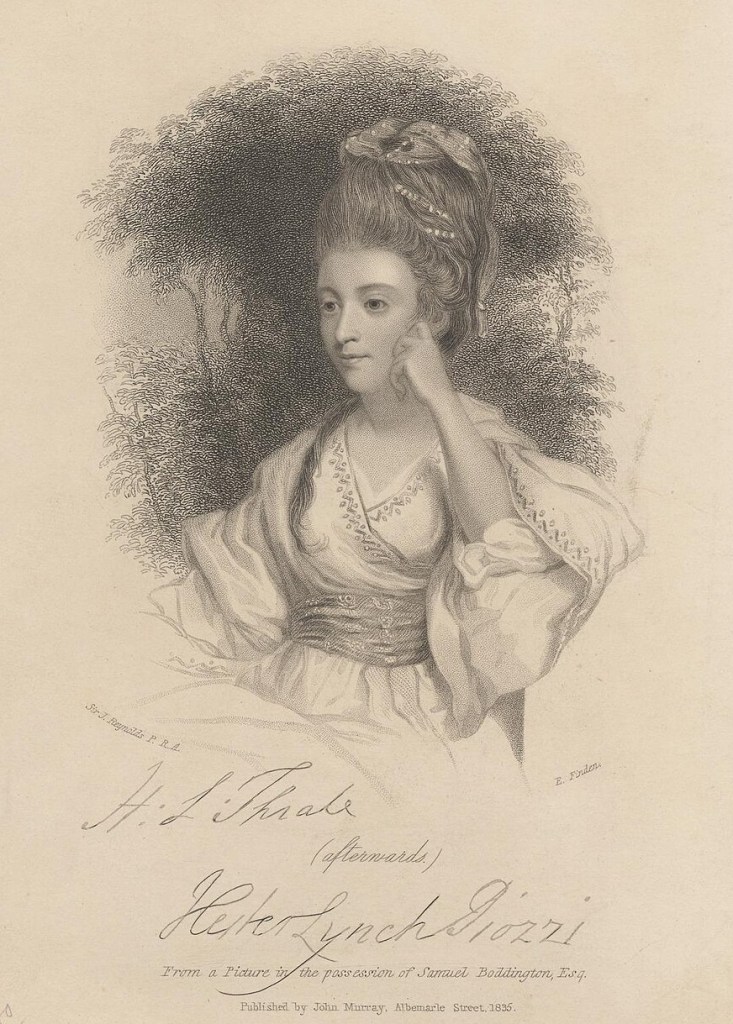
Hester Lynch was a child prodigy raised with great expectations. She could read and translate French by the age of six and later impressed guests by reciting long passages of Milton’s Paradise Lost. Her family were aristocratic but poor and relied on the promise of an inheritance for Hester from rich relations. When that fell through Hester was married off against her will to a rich brewer, Henry Thrale. Henry became a member of parliament and expected his wife to host lavish dinner parties, all while bearing twelve children, eight of whom died young. Hester kept a journal, later published, confiding her anguish about her children, but in public she was a charming, witty hostess. At one point she lost three children in under a year but continued to dazzle her guests. One of these was Frances Burney, who called her first visit to the Thrales “the most consequential day I have spent since my birth.” Male guests were impressed with her erudition:
Mrs. Thrale is a very learned lady, and joins to the charms of her own sex, the manly understanding of ours.
Through their entertaining the Thrales knew all the great names of the day, including Edmund Burke and Samuel Johnson with whom Hester became close friends. When Henry died in 1781 Hester was immediately besieged by suitors and gossip; men even put wagers on who she would marry. But Hester shocked them all by falling in love with an Italian musician, Gabriel Piozzi. This caused a scandal. Piozzi could not have been more unsuitable, a lower class, a foreigner, and a Catholic. Frances Burney was among those trying to dissuade her from the relationship:
while she possessed her Reason, nothing could seduce her to approve what Reason itself would condemn: that Children, Religion, Situation, Country & Character were too much to Sacrifice to any One Man.
Hester’s conflicts over society’s expectations and her own happiness all went into her journal, which Romney finds as riveting as any Gothic tale. Under pressure from her eldest daughter Hester broke off the relationship with Piozzi who returned to Italy. But in the following year her health broke down under the strain of nursing and losing another child. Her daughter relented, Piozzi was summoned back to England and they wed. But turmoil was not over; society was horrified, her friends abandoned her, and the press picked up the scandal. The couple even had scurrilous cartoons printed about them.

But Hester was happy, and now turned to a long-standing ambition – writing. Between 1786 and 1801 she published five books. The first was Anecdotes of the late Samuel Johnson published just a year after his death. The book was so popular it sold out within hours. When the king sent for a copy on the evening of publication there were none left; the publisher sent his own copy. Despite her notoriety, or perhaps because of it, all her books were bestsellers. Observations and Reflections Made in the Course of a Journey was an account of her European honeymoon, a case of flinging her happiness in the face of her disapproving critics. Frances Burney, now Keeper of the Robes at court, read the book together with Queen Charlotte. She recorded in her diary:
How like herself, how characteristic in every line! Wild, entertaining, flighty, inconsistent, and clever!
It is believed that Ann Radcliffe relied on this book for her descriptions of Europe in Udolpho, as she had not yet traveled there. All Piozzi’s books were in the library of Jane Austen’s brother Edward at Godmersham Park where Austen was a regular visitor, and Piozzi is frequently mentioned in her letters to her sister Cassandra.
Hester Thrale Piozzi remained controversial throughout her long life. After her death her literary reputation was overshadowed by the larger than life figure of her friend Samuel Johnson. Soon her name only came up in literary histories for her connection with him. Romney points out that rare book dealers always mention Johnson prominently when offering her books for sale as though that is their only value. But in combining traditional forms like biography and travelogue with personal reflections, Piozzi invented a new style that is refreshingly modern.
Maria Edgeworth (1768-1849)
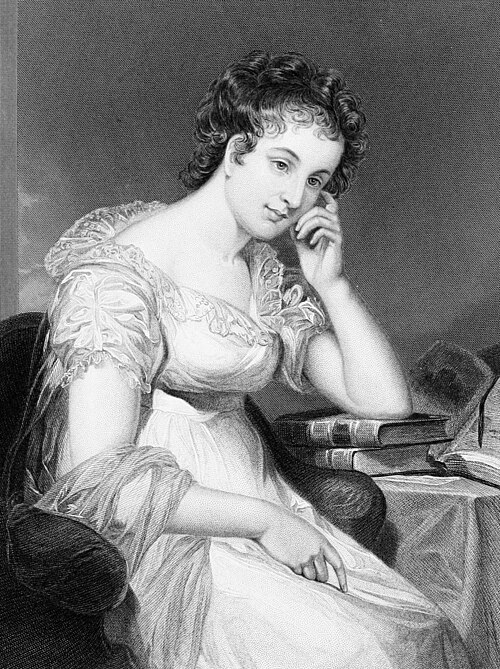
Maria Edgeworth was one of the most popular novelists of the early nineteenth century, a favorite of Jane Austen and of Maria Bronte, mother of the Bronte sisters. Austen wrote to her niece Anna Austen:
I have made up my mind to like no Novels really, but Miss Edgeworth’s, Yours & my own.
Romney describes her thrill when she acquired a copy of Emma owned by Edgeworth, in fact sent to her by the younger aspiring author. Edgeworth’s signature is on the title page. She was considered the greatest writer of her generation at the time, and Walter Scott who followed in the next generation, acknowledged his debt to her. In the preface to Waverley, the first of his Scottish historical novels, he wrote that he sought to emulate her.
Edgeworth was of Anglo-Irish heritage and lived most of her life at her father Richard Lovell’s estate Edgeworthstown in County Longford where she was privately tutored. Her father was an important influence on her life and championed her writing career, though like Hannah More’s father he wanted her to focus on educational subjects. Fortunately she had a mind of her own. The family was unusual; Lovell had twenty-two children by four wives (one can imagine them dying of exhaustion one by one). Maria was the second eldest to survive to adulthood and spent much of her youth tending to younger siblings. This is probably what inspired her to write books for children as well as adults.
Edgeworth’s first novel Castle Rackrent was a saga of the decline of an Anglo-Irish landed family much like her own, but told from the point of view of the Catholic Irish peasantry. She followed it with Belinda, a courtship novel about a young woman entering society who is taken under the wing of Lady Delacour, a celebrated society wit and cynic. (Reading about this character I immediately thought of Lady Danbury in Bridgerton). Austen’s stated goal when she began work on Emma was to write something as good as Belinda. Edgeworth reached the peak of her fame and popularity with Ennui and The Absentee, novels of fashionable life that also explored issues of social reform that would later dominate the Victorian novel.
On reading Edgeworth’s novels Romney was puzzled as to why she was dropped from the Canon so completely. Surveying the Victorian and early twentieth century critics she found that Edgeworth became pigeon-holed as a regional Irish writer. She suffered in comparisons to Austen in supposedly lacking a universal appeal. Debatable, but the Irish in me has put Castle Rackrent on my summer reading list.
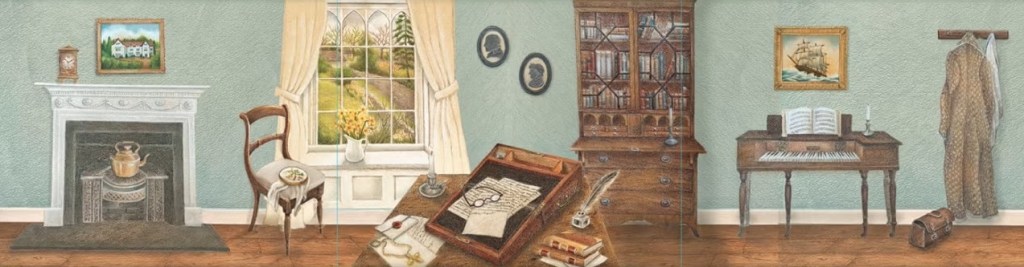
Rebecca Romney’s years long project of collecting and reading books by women authors of Jane Austen’s era led her to question:
… the lie I had once believed so easily, that there were no great women writers in English before Austen. Austen knew the truth. There were quite a few. She read these writers, enjoyed their work, and hoped to be as great as they were.
As I read about these women a question occurred to me that is posed each week in The Washington Post Book World to the author they interview. Which three literary figures would you invite to a dinner party? Of this group I have my answer. Elizabeth Inchbald and Hester Piozzi for their wit and spunk, and I have to include Charlotte Smith to give the poor woman a break from her travails. Hannah More, I’m sorry, but I’m afraid you would be too judgmental about the other guests.
Enjoy your summer reading, and perhaps you’ll consider adding one of these long forgotten classics to your own list.


Love the pictures and the bounty of information. Jane Austin is truly wholesome in all parts of her life. Thank you DOTFL. God bless and I look forward to reading more of your works!
LikeLike