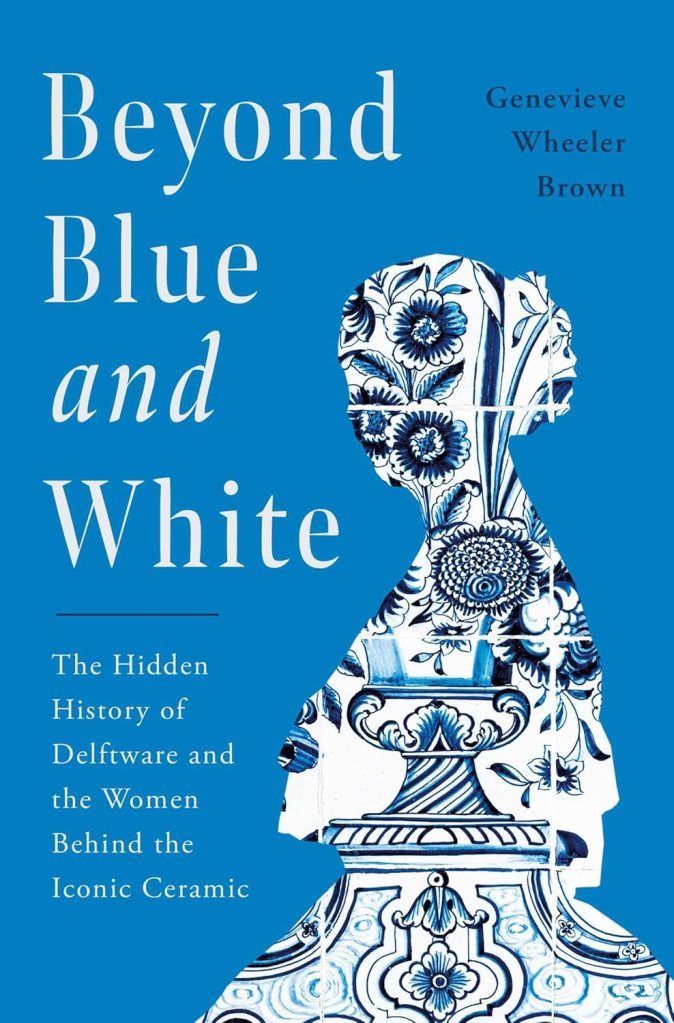
Beyond Blue and White

The first thing I want to say about this new addition to my bookshelf is that I absolutely adore the cover. I don’t believe in judging a book by its cover, but I do judge book covers. I follow the Best Book Covers of the Year lists and pass my own judgements on the latest design hits and misses. When will the cliche of the “young woman seen from behind” covers be over? The current fashion is for splashes of garish color and odd images designed to shock or defy explanation. In contrast this cover is an inspired fusion of subject and image. The perfect Delft blue color, of course, and the woman-shaped shard of Delftware have an instant visual appeal and tell the story of the book’s contents – the revelation that many of the famous Delft potteries of the 17th and 18th centuries were owned and managed by women.

Genevieve Wheeler Brown is a decorative art advisor who stumbled on this story by chance when she was asked to appraise a large collection of Delftware stored in the New York headquarters of a women’s art organization. When she stepped into the room, untouched for decades, she was amazed to find a superb collection of over seventy-five blue and white Delftware objects, an overwhelming display of beauty and craftsmanship in a myriad shapes and sizes. This treasure, she learned, had been acquired in the Gilded Age when a fashion for collecting Delftware had obsessed wealthy New York socialites. Brown soon became obsessed herself with researching the history of Delftware.

Continue reading “Beyond Blue and White”

Maria: The Forgotten Bronte

On My Bookshelf the biography of Maria Branwell Bronte, mother to genius.

So much has been written about the Bronte sisters, their brother Branwell, and father Patrick, that we can easily imagine we know them intimately. But one member of this extraordinary family, their mother Maria, remained a shadowy figure until the publication of this first full biography in 2019. In earlier books we glimpsed Maria on her deathbed in the Haworth parsonage crying out in despair “Oh my poor children!” Then she conveniently slipped away, leaving her children to endure the motherless youth that inspired their genius writings. What would Jane Eyre be, after all, without Charlotte’s miserable experience at Cowan Bridge School, the inspiration for Lowood. As far as literary history was concerned, Maria had served her purpose.

So it is revelatory to meet the lively, intelligent, capable young woman who won Patrick Bronte’s heart. And the young Irish curate himself is very different from the severe elderly parson, seen always bent over his books, who lived out a long lonely widowhood. 

Maria Branwell’s early life was more Jane Austen than Bronte. As a member of the gentry she enjoyed a life of festive balls in the Assembly Rooms, theatre in the Playhouse, fine dining, fashionable clothes, and afternoon visits for tea with her many friends. Instead of the bleak Yorkshire moors there was the bustling seaport of Penzance in Cornwall, a scenic little town known for its festivals, smugglers, and mild climate. Sea breezes perhaps, but no wuthering. 

Continue reading “Maria: The Forgotten Bronte”

The King’s Bedpost

On My Bookshelf I find a favorite history book about a very strange painting…

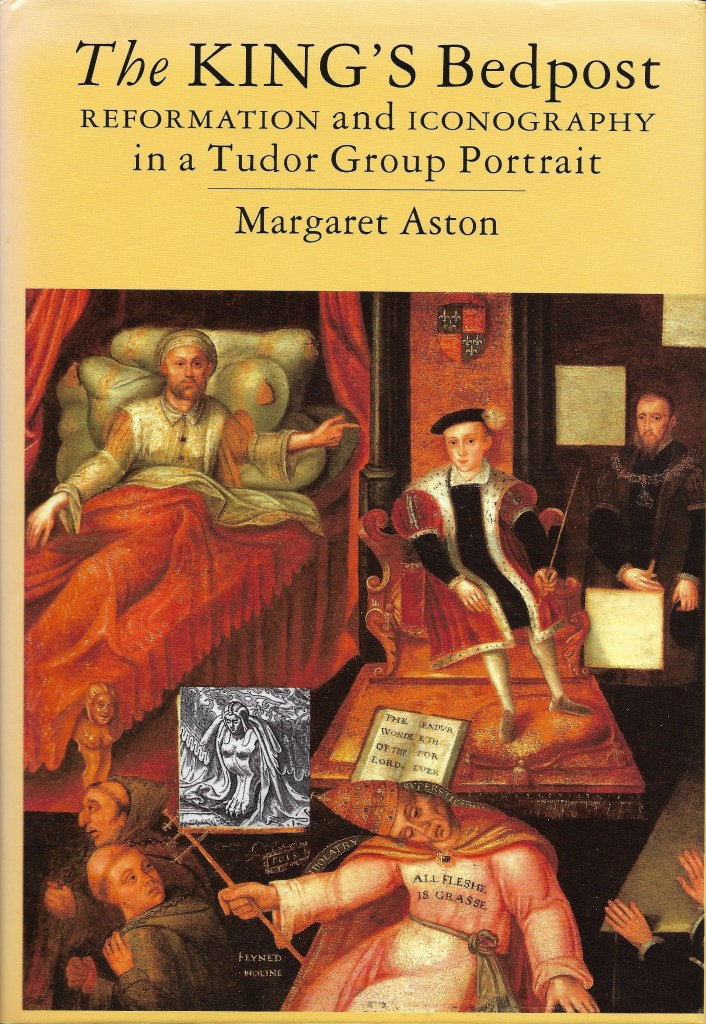
             Edward VI and the Pope, unknown artist, oil on wood, c1575

At first glance, maybe even a second or third, this is a mess of a painting. It’s busy with awkwardly positioned figures and decorative elements; there’s nowhere for the eye to rest. The viewer’s eye darts about the various unrelated parts trying to make sense of it all. Then there are the blank squares and the puzzling scene in the upper right, a picture within a picture. The artist is obviously trying to say something, but what?

As Margaret Aston explains in The King’s Bedpost it is best to think of it, not as a painting, but as a comic strip or political cartoon. The blank squares were intended to hold text, just like the speech bubbles of today. For unknown reasons they were not all filled in. The book turns that old saying, a picture is worth a thousand words, on its head, for it takes many thousands of words to explain this one. The painting may be no masterpiece but, Aston says, “undistinguished art can make interesting history.

Explaining the painting takes us on a journey through the Old Testament Kings, sixteenth century Dutch art, crucial decades of the English Reformation when much of the medieval heritage of religious art was destroyed by iconoclastic reformers, and even into Elizabeth I’s private chapel. The painting is visual propaganda for the reformers’ view that all religious images and devotional objects were “Popish abominations” akin to pagan idolatry. Once thought to have been painted during the reign of the boy King Edward VI, seen seated in his Chair of State mounted on a dais, Aston shows that it actually reflects the religious conflicts and anxieties of Elizabeth I’s reign. She also details evidence that the source materials for the painting date to the 1570’s. For the unknown artist’s skills were limited, note the unconvincing size and position of the hands, so he copied much of the painting from other works. This dating is confirmed by the modern science of dendrochronological analysis; the wood panel comes from a tree that was cut down between 1574 and 1590.

Aston begins by identifying the people in the painting, recognizable because they are copies of portraits by various artists produced in the 1560’s and 70’s.. She draws our attention to a horizontal line following the base of the king’s dais dividing the painting into upper and lower sections, upper being good and lower bad. Fashion also divides the groups. In the lower section several of the men sport tonsures, the monastic hair style, branding them as Catholics. In the upper section there are no tonsures but copious beards, the style favored by the Protestant reformers.

Continue reading “The King’s Bedpost”

From Abbess Roding to Yubberton

On My Bookshelf I discover the weird and wonderful history of English Place Names.

If you spend enough time in Great Sinns, Cornwall, you may find yourself on the road to Purgatory, Oxfordshire. Don’t take the fork to Pity Me, Durham, but seek forgiveness in Come-To-Good, another picturesque Cornish hamlet. Concocting imaginary itineraries like this is one of the pleasures of reading English Place Names by H. G. Stokes published in 1948. My copy shows its age, a bit tattered and worn. Stokes writes like a rather stuffy pedantic local history enthusiast, but his book is full of fascinating facts about the origin of English place names, many of them downright Rhude (Durham) like Mucking (Essex), Spital-in-the-Street (Lincolnshire), and Stank (Yorkshire).

English place names, according to Stokes, originated as simple colloquial descriptions, word pictures of a place. Before the age of maps or GPS people found their way from place to place by carrying the word pictures in their heads. By studying the original meanings of the words we can see a picture of what England looked like as much as 2,000 years ago. The words describe a rural landscape of woodland and heath, marsh and fen, hills and valleys, rivers and streams, dotted with dwellings and small settlements. Most of the oldest names are Celtic and Anglo-Saxon. Here are some of the most common name fragments and their meanings:

Continue reading “From Abbess Roding to Yubberton”

Lines on the Underground

On My Bookshelf I rediscover a book I bought by mistake…

Have you ever bought a book thinking it was one thing and it turned out to be quite another? That’s what happened when I picked up this book in a London used book store years ago. I thought Lines on the Underground referred to the London Transport project of posting lines of poetry in the trains to give strap-hanging commuters something more interesting to read than ads. Started in January 1986 as an experiment, the project was so popular it continues to this day. I knew an anthology of the poems had been published and I assumed this was it, adding it to the pile of books I always end up buying when in London.

But when I got home and opened it up I found something quite different, but marvelous in its own way, with a clever pun in the title. This book contains not only lines of poetry but prose as well, quotations from literature, guidebooks, and historical writing from myriad sources past and present. The book is arranged by Underground Line with each station in order of travel receiving one or more quotations. So you could ride on the Circle Line, for example, book in hand, and follow along station by station with interesting snippets of reading about each place. All 270 stations that existed at the time of publication in 1994 are covered.

Continue reading “Lines on the Underground”

The Film of Murder in the Cathedral

On My Bookshelf for National Poetry Month I find a book on a film of a play by a poet, the verse drama Murder in the Cathedral by T. S. Eliot. It is a story of faith, conscience, power, and murder. 

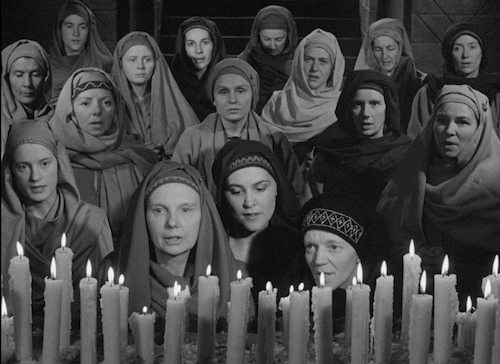
I first saw this film decades ago when I was a student. Of all the films one sees in a lifetime only a few leave indelible images in the memory. I think of the first appearance of Death in Ingmar Bergman’s The Seventh Seal. And just as powerful, the chorus of women in Murder in the Cathedral who kneel in prayer and intone the sonorous words:

Since golden October declined into sombre November
And the apples were gathered and stored, and the land
became brown sharp points of death in a waste of water and mud,
The New Year waits, breathes, waits, whispers in darkness…


Now I fear disturbance of the quiet seasons:
Winter shall come bringing death from the sea,
Ruinous spring shall beat at our doors,
Root and shoot shall eat our eyes and our ears,
Disastrous summer burn up the beds of our streams
And the poor shall wait for another decaying October..


Some malady is coming upon us. We wait, we wait.

It is easy to discern the voice of the poet who wrote “April is the cruelest month,” the famous first line of The Waste Land. The chorus chant of the sufferings of the poor and set a tone of anguish and foreboding for the event to come.

The chorus – scene from the film
Continue reading “The Film of Murder in the Cathedral”

The Women Troubadours

On My Bookshelf I find a volume perfect for Women’s History Month, the story of medieval women songwriters whose words sound as fresh as if they were written today.

The troubadour is a familiar figure in Medieval history, a singer of songs of unrequited love for a beautiful and virtuous lady. But women troubadours? They were virtually forgotten until Meg Bogin published this study in 1976, the first since a German monograph in 1888. The book includes translations of the 23 songs that survive by 20 women. These voices from almost a thousand years ago are remarkably fresh and intimate, giving us a rare window into the lives of women in an age dominated by men.

Continue reading “The Women Troubadours”

What is History?

In this edition of On My Bookshelf I rediscover a history lesson.

This little paperback was published by Pelican Books, an imprint founded by Penguin Books in 1937 to offer intellectual nonfiction to ordinary people for “no more than the price of a packet of cigarettes.” The books were very popular in the postwar period, The Guardian calling them an “informal university for ’50s Britons.” My copy of What is History? by E. H. Carr was published in 1965 and shows its age. The pages are not so much yellowed as nicotine colored but the spine has held up. When I open it, for the first time in decades, I see a dedication written inside. A friend gave it to me for Christmas in 1965. She signed it with her schoolgirl nickname which I will refrain from sharing with the world to preserve her dignity. She is one of the few friends from that long ago time I am still in touch with.

What led me back to this book after so long? I remembered it and thought it might shed light on the current controversy over the teaching of history, particularly the history of slavery and race in America. I was not disappointed. This is one of the first relevant quotes I came across:

“There is no more significant pointer to the character of a society than the kind of history it writes or fails to write.

Continue reading “What is History?”

Great British Cooking?

In this episode of On My Bookshelf I reach for a cookbook.

“How do you make Toad in the Hole?” asked my 8 year old grandson. “Well, first I send you boys into the woods to find some toads while I make the holes,” I replied. “Then you drop the toads into the holes and we’re done.” The 6 year old looked confused but 8 was on to me. “That’s not true!” he protested. So I explained that the English give weird names to their foods but basically Toad in the Hole is just sausages in Yorkshire Pudding. That drew blank stares so I revised it to a sausage pancake. They liked the sound of that and agreed to help me, though once the Yorkshire Pudding batter was mixed they lost interest. I have the recipe for this and more odd sounding foods in Great British Cooking by Jane Garmey. I bought the book when it was first published in 1981, a time when the title was indeed an oxymoron. This was before the age of celebrity chefs like Gordon Ramsay and Jamie Oliver, before pubs turned into gastropubs, and before the Great British Bake Off came to America. British cooking really did have a terrible reputation, especially with Continental Europeans. 

Continue reading “Great British Cooking?”

Reading Bruegel

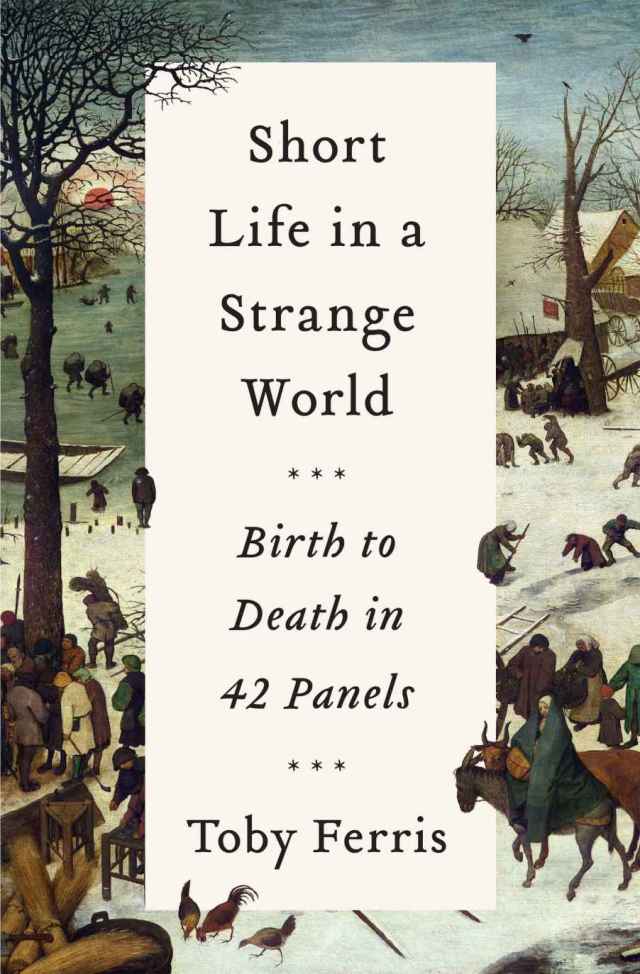
I bought this book on impulse because I will read anything about Bruegel. Perhaps it is my Flemish heritage that draws me to his work. I imagine my ancestors among the peasant crowds in his village scenes. It was only when I held the book in my hands that I recognized the author’s name. Toby Ferris wrote for The Dabbler, the site that first hosted my Dispatches, and he created Anatomy of Norbiton, a web site “exploring suburban life and universal failure as seen through the lens of Renaissance art.” My brother, the writer Frank Key, called it “a thing of strange and terrible beauty.” So I opened this book with heightened expectations. It would be no ordinary book about Bruegel.

There are 42 surviving paintings by Pieter Bruegel the Elder. He lived about 42 years, his birth year of 1525 is an approximation. Ferris was 42 and had recently lost his father when Continue reading “Reading Bruegel”